



Table of Contents
Introduction
The Berkey has been the default recommendation in prepper, homesteading, and off-grid communities for over a decade, and for good reason. It filters water without electricity or plumbing, it makes bad-tasting municipal water drinkable, and the stainless steel chambers are built to last decades. At around $367 for the two-filter Big Berkey, it has earned a loyal following from people who want a reliable gravity-fed system that works when the grid goes down.
But 2026 is a complicated year to buy one. An ongoing EPA regulatory dispute has effectively removed the original Black Berkey filter elements from the US market, a consumer class action filed in late 2022 remains unresolved, and the brand has never pursued NSF/ANSI certification for its flagship Black elements. Meanwhile, Trustpilot rates the Berkey Store 4.5 out of 5 — “Good”, with complaints about customer service, restocking fees, and products that do not perform as advertised. This review separates the genuine off-grid value from the legal, certification, and support problems so you can decide whether a Berkey still makes sense in 2026.

What Is The Berkey?
The Berkey is a gravity-fed water filtration system manufactured by New Millennium Concepts, Ltd. (NMCL). It consists of two stacked stainless steel chambers: water poured into the upper chamber passes through purification elements by gravity alone and collects in the lower chamber, ready to dispense from a spigot.
Key aspects of the system include:
- No electricity or plumbing required — a genuine advantage for off-grid and emergency use
- AISI 304 stainless steel chambers that owners routinely report as perfect after 8–10 years of use
- Black Berkey purification elements, which use microporous filtration combined with ion exchange
- A 2.25-gallon capacity on the Big Berkey, suitable for 1–4 people daily, with emergency capacity rated for up to 85 people per day
- A lifetime warranty on stainless steel chambers and a 2-year warranty on filter elements
- Prices ranging from roughly $300 to $415 depending on size and configuration
The brand’s identity is built on independence from infrastructure rather than on third-party certification or modern convenience.
Design and Build Quality
Build quality is the least controversial part of the Berkey story. The stainless steel chambers are widely praised as durable, attractive, and virtually indestructible, and long-term owners consistently report that the housing outlasts the filter elements by years.
What works well:
- The passive, gravity-fed design means there are no pumps, electrical connections, or plumbing fittings to fail.
- The stacked chamber layout is simple and intuitive, and the spigot is easy to use.
- The stainless steel housing resists rust and damage, and Berkey offers a lifetime replacement warranty on hardware components like spigots and washers
- The capacity is genuinely useful for households of one to four people, and the emergency rating of 85 people per day is a legitimate standout for group scenarios
Where the design falls short:
- The system is slow. Reddit users describe it as “agonizingly slow,” with one noting it would not filter a full tank in days under certain conditions
- Setup instructions are frequently criticised, with one Amazon reviewer saying they “sucked” and required help from a friend
- The spigot is a weak point, with at least one owner replacing the original after it broke under use by children
| Component | Feedback |
|---|---|
| Stainless steel chambers | Excellent — durable, lifetime hardware warranty |
| Gravity-fed operation | Simple and reliable, no power needed |
| Filtration speed | Slow — a common complaint |
| Spigot | Functional, but can break with heavy use |
| Setup instructions | Poorly regarded by many buyers |
Filtration Performance: What It Actually Removes
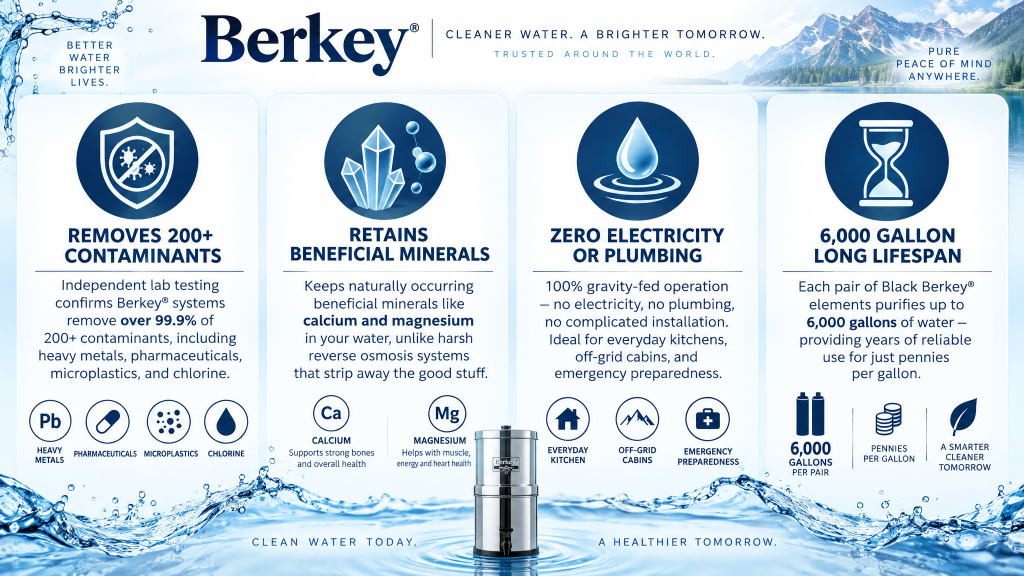
Filtration performance is where The Berkey reputation is strongest for some contaminants and weakest for others, and the gap between marketing and independent testing matters.
What independent testing confirms:
- Chlorine, chloroform, and total trihalomethanes are reduced by near 100%, consistently across multiple tests
- Lead, copper, barium, and manganese are also reduced by near 100%
- Heavy metals including lead, mercury, chromium-6, and cadmium test at greater than 99.9% reduction in Berkey’s own testing and are widely confirmed by long-term owners
Where the performance claims break down:
- Molybdenum was reduced by only about 25% in one independent lab test
- Selenium showed no measurable reduction at all in another round
- Cobalt came back reduced by just 3% in one test, despite Berkey’s own published figure of 95% for that same contaminant
- Fluoride and arsenic are not removed by the standard Black elements at all and require the separate PF-2 add-on filter
- Berkey has publicly withdrawn its earlier claims about removing bacteria and viruses, meaning the system should not be treated as a substitute for proper disinfection when the source water has not already been treated
| Contaminant | Approximate Reduction | Consistency |
|---|---|---|
| Chlorine, THMs | Near 100% | Strong |
| Lead, copper, barium | Near 100% | Strong |
| Molybdenum | ~25% | Weak |
| Selenium | No measurable reduction | Weak |
| Cobalt | ~3% (vs 95% claimed) | Weak, inconsistent |
| Fluoride, arsenic | Not removed without PF-2 | Requires add-on |
| Bacteria, viruses | Claim withdrawn | Not a disinfectant |
The Certification and Lawsuit Problem
This is the part of The Berkey story that any honest review must confront directly, because it affects both the product’s credibility and its availability in the United States.
The NSF certification gap:
- Black Berkey elements do not carry NSF/ANSI certification. Berkey has never sought it, relying instead on its own independent laboratory testing
- A live NSF/ANSI 42 listing applies only when the system uses Phoenix Gravity New Millennium Edition elements, not the standard Black Berkey package
- Critics, including Wirecutter, have tested Berkey filters and found results inconsistent with Berkey’s own claims, which the company disputes
The consumer class action:
- A consumer class action filed in late 2022 alleges that Black Berkey elements do not perform as advertised, with plaintiffs claiming the filters were “nothing more than an empty can or plastic bottle”
- The lawsuit focuses on false advertising and product misrepresentation, not physical harm
- As of early 2026, no public settlement or final ruling has been confirmed
The EPA dispute:
- NMCL has filed lawsuits against the EPA challenging the agency’s 2023 classification of Black Berkey elements as a regulated pesticide device
- The EPA issued Stop Sale orders against Berkey’s distributors in 2022 under FIFRA, citing the silver antimicrobial claim in the Black elements, which has effectively removed the original elements from the US market
| Issue | Status | Impact on Buyers |
|---|---|---|
| NSF/ANSI certification | Not held for Black elements | No independent third-party verification |
| Consumer class action | Filed late 2022, unresolved | Allegations of false advertising |
| EPA classification | Active dispute, Stop Sale orders | Original Black elements unavailable in US |
| Phoenix element listing | NSF/ANSI 42 applies | Only with specific replacement elements |
Pricing and Long-Term Value
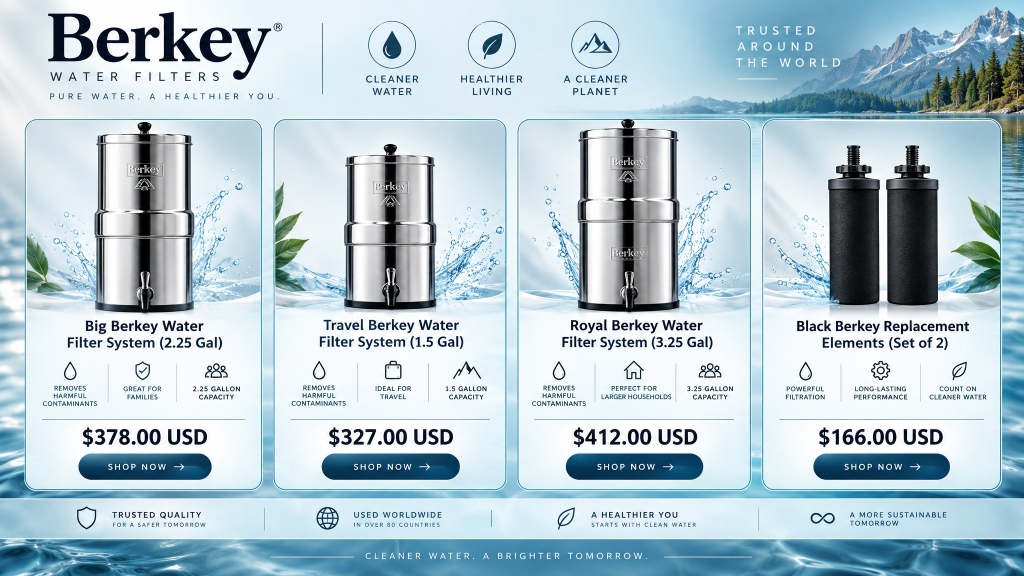
Berkey’s upfront cost is high, but its long-term cost per gallon is genuinely among the lowest of any countertop filter system.
Typical pricing:
- Big Berkey (2.25 gal, 2 filters): around $367 as of mid-2026
- Travel Berkey (1.5 gal): lower, depending on configuration
- ProOne Big+: around $280 for a comparable gravity system
- Sawyer Complete 4L: around $50, far cheaper but smaller and less durable
Long-term operating cost:
- A pair of Phoenix elements costs around $120** and is rated for **5,500 gallons**, working out to roughly **$0.02 per gallon
- Black elements are rated for 6,000 gallons per pair, with a replacement cost around $120**, also landing near **$0.02 per gallon
- By comparison, a Culligan MaxClear costs about $1.38 per gallon** in filters, and a Rorra pitcher costs about **$0.37 per gallon
| System | Upfront Price | Cost Per Gallon (Filters) |
|---|---|---|
| Big Berkey | ~$367 | ~$0.02 |
| ProOne Big+ | ~$280 | Varies |
| Sawyer Complete 4L | ~$50 | Low, but smaller capacity |
| CuraLlex MaxClear | ~$69 per filter | ~$1.38 |
| Rorra Pitcher | ~$199–$249 | ~$0.37 |
The value case is strongest for buyers who will actually use the system daily and keep it for years, because the upfront cost is offset by the exceptionally low cost per gallon. It is weakest for occasional users or anyone who needs fluoride removal, because the PF-2 add-on filters increase both upfront and ongoing costs.
Customer Experience: The Support and Trust Problem
This is the weakest part of The Berkey story in 2026, and the evidence is consistent across multiple independent platforms.
Trustpilot rating: The Berkey Store is rated 4.5 out of 5 — “Poor” on Trustpilot, with reviews describing products that do not work as expected and customer service that is difficult to reach
Recurring complaints:
- A Google Shopping reviewer wrote simply: “Stay away, terrible customer service” and described a “punitive restocking fee” on returns
- A BBB complaint states that the filter “does not work as they say” and that the buyer tried several times to contact the company with no call back and no response to emails
- A Trustpilot reviewer described a Berkey shower filter that made water trickle so slowly it took 40 minutes to rinse shampoo, leaving hair feeling dirty and the scalp itching
- A Reddit user reported diarrhea after visiting friends who use a Berkey, and noted that water pumped from a quarry still had a slight smell even after filtration
- A separate Reddit user said their Berkey was “agonizingly slow” and would not filter a full tank in days
Positive experiences do exist:
- A French reviewer whose spigot arrived damaged received a replacement the next day after emailing the local branch, and praised the responsiveness
- Long-term owners on Amazon and Berkey’s European site describe years of reliable use, improved taste, and significant savings versus bottled water
| Platform | Rating / Feedback |
|---|---|
| Trustpilot (Berkey Store) | 2.5/5 — “Poor” |
| BBB | Complaints about non-functioning filters and unresponsive support |
| Mixed — praise for off-grid use, complaints about speed and smell | |
| Amazon | 4.5/5 on some listings, but mixed on setup and spigot quality |
| Common complaints | Poor support, restocking fees, slow filtration, certification doubts |
Pros and Cons
| Pros | Cons |
|---|---|
| Works without electricity or plumbing | Original Black elements unavailable in the US due to EPA Stop Sale orders |
| Durable stainless steel chambers with lifetime hardware warranty | No NSF/ANSI certification for Black elements |
| Exceptional long-term cost per gallon (~$0.02) | Consumer class action alleges filters do not perform as advertised |
| Strong removal of chlorine, lead, and heavy metals | Does not remove fluoride or arsenic without PF-2 add-on |
| Large capacity suitable for households and emergencies | Bacteria and virus removal claims have been withdrawn |
| Simple, passive operation | Filtration is slow |
| Strong reputation in off-grid and prepper communities | Customer service rated poorly on Trustpilot and BBB |
The Berkey vs. Standard Alternatives
How does The Berkey compare to other gravity filters and countertop systems in 2026?
| Feature | Big Berkey | ProOne Big+ | Sawyer Complete 4L | Culligan MaxClear |
|---|---|---|---|---|
| Price | ~$367 | ~$280 | ~$50 | ~$69 per filter |
| NSF/ANSI Certified | Only with Phoenix elements | Yes | Yes | Yes (lead certified) |
| Fluoride Removal | Optional PF-2 | Some models | No | Some models |
| Cost Per Gallon | ~$0.02 | Varies | Low | ~$1.38 |
| Capacity | 2.25 gal | Comparable | 4L | Pitcher/dispenser |
| Best For | Off-grid, long-term use | Certified gravity filtration | Budget emergency use | Certified lead removal |
The Berkey’s advantage is its combination of capacity, durability, and low long-term cost. Its disadvantage is the certification and legal uncertainty that now surrounds the Black elements. ProOne offers a certified gravity alternative, Sawyer offers a far cheaper emergency option, and Culligan offers certified lead removal in a more conventional format. For a buyer who prioritises certification above all else, the Berkey is no longer the default choice.
Verdict and Final Thoughts

The Berkey is still a capable off-grid water filter, and for buyers who already own one and have a supply of working elements, it remains a useful tool. The stainless steel housing is excellent, the long-term cost per gallon is genuinely exceptional, and the passive operation is a real advantage in emergencies. For homesteaders and preppers filtering municipal or well water for chemical contaminants and heavy metals, it can still do the job.
But 2026 is not the year to buy a Berkey without understanding the risks. The original Black elements are unavailable in the US because of EPA Stop Sale orders, the company has never held NSF certification for those elements, a consumer class action alleging false advertising remains unresolved, and customer service is rated poorly on Trustpilot. These are not minor caveats. They affect whether you can get replacement filters, whether the product performs as claimed, and whether you have recourse if something goes wrong.
Who is the Berkey best for?
- Existing owners who already have a supply of working elements and understand the maintenance requirements
- Off-grid and emergency-preparedness users who prioritise independence from electricity and plumbing
- Buyers in regions where the original Black elements are still legally available and who do not need NSF certification
- Homesteaders filtering known municipal or well water for taste, chlorine, and heavy metals
Who should look elsewhere?
- First-time buyers in the US who need a currently available, certified system
- Anyone who needs guaranteed fluoride, arsenic, or bacteria/virus removal (the Berkey does not provide this without add-ons or disinfection)
- Shoppers who prioritise responsive customer support and easy returns
- Buyers who are not comfortable with the legal and regulatory uncertainty surrounding the Black elements
Overall, The Berkey is a product with a strong heritage and a complicated present. The hardware is excellent, the filtration performance for key contaminants is well-documented, and the long-term economics are compelling. But the certification gap, the EPA dispute, the class action, and the poor customer service record mean that buying one in 2026 requires more caution than the brand’s reputation suggests. For the right buyer, it is still a useful tool. For everyone else, a certified alternative may be the safer choice.
Considering a Berkey? Confirm that the elements you are buying are legally available in your region, check whether the system includes the PF-2 filters if you need fluoride removal, and read the return policy carefully before ordering.
Scorecard
| Category | Rating |
|---|---|
| Build Quality & Durability | ⭐⭐⭐⭐⭐ |
| Filtration Performance (Key Contaminants) | ⭐⭐⭐⭐ |
| Certification & Transparency | ⭐⭐⭐⭐ |
| Long-Term Value | ⭐⭐⭐⭐⭐ |
| Customer Support & Trust | ⭐⭐⭐⭐ |
| Overall Rating | 4.2/5 |