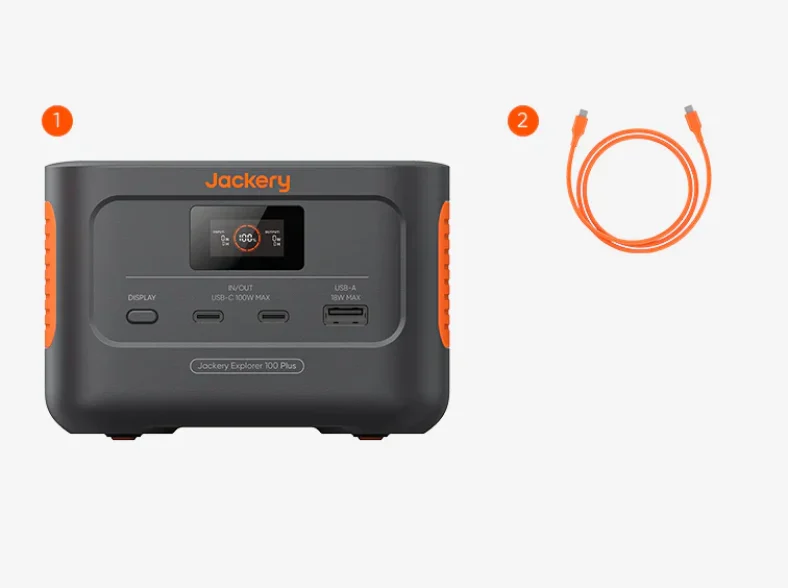
The Jackery Explorer 100 Plus is a small, lightweight portable power station. It has a 99 watt-hour (Wh) lithium battery, which is just under the 100 Wh limit for carry-on luggage on most airlines. It can charge smartphones, tablets, drones, mini fridges, lights and small laptops. It includes one AC outlet (100W max), two USB-A ports and one USB-C port (60W input/output). The unit can be recharged from a wall outlet, a car lighter socket or a compatible solar panel. The Explorer 100 Plus is ideal for weekend camping trips, road trips and emergency home backup for small devices. This review covers the key specifications, real capacity, charging speed, included accessories and how it compares to similar products from Goal Zero and Anker.
Key Specifications Of The Jackery Explorer 100 Plus
The table below summarises the core specifications based on the product listing and expert reviews.
| Feature | Specification |
|---|---|
| Battery Capacity | 99 Wh (equivalent to 128 Wh at 3.6V cell rating) |
| Battery Chemistry | Lithium-ion (NMC) |
| AC Output | 1 outlet, 100W max (120V, pure sine wave) |
| USB-A Output | 2 ports, 12W each (total 24W) |
| USB-C Output | 1 port, 60W max (Power Delivery 3.0) |
| Car Port Output | 1 outlet, 96W max (12V/8A) |
| AC Input (wall charging) | 65W (approx 2 hours to full) |
| Solar Input | 100W max (12-30V, 4A) |
| Solar Recharge Time | Approximately 2.5 hours (with 100W panel) |
| Car Recharge Time | Approximately 2.5 hours (12V car socket) |
| Pass‑Through Charging | Yes (charge while powering devices) |
| Weight | 2.9 lbs (1.3 kg) |
| Dimensions | 8.1 x 5.6 x 3.1 inches |
| Operating Temperature | 14°F to 104°F (-10°C to 40°C) |
| Warranty | 2 years (extendable to 3 years with registration) |
| Price | Approximately 129‑159 USD |
The Explorer 100 Plus uses lithium-ion NMC cells. These are lighter than LiFePO4 (lithium iron phosphate) batteries but have a shorter cycle life (approximately 500 cycles versus 2,000‑3,000 cycles for LiFePO4).
Design And Portability
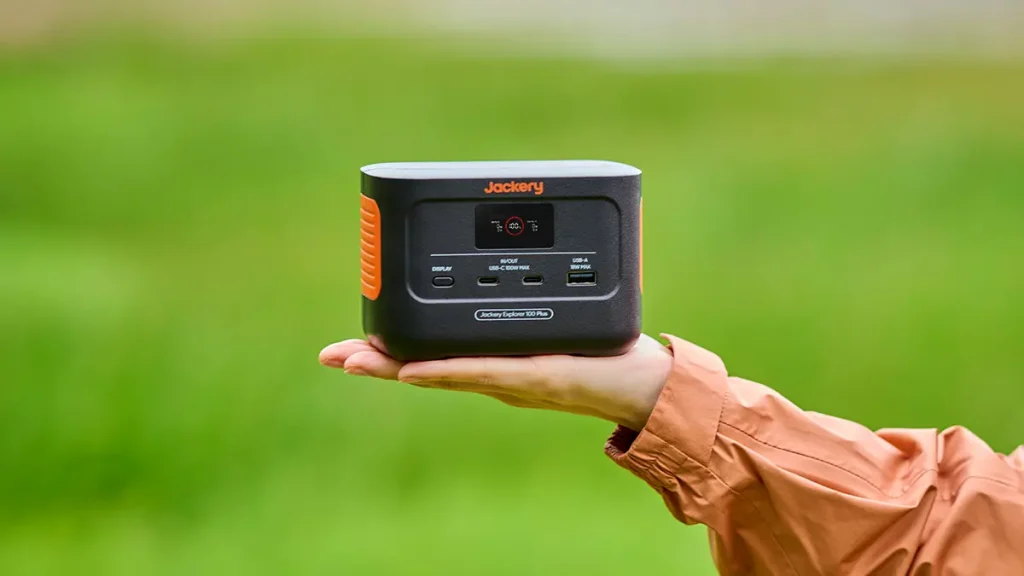
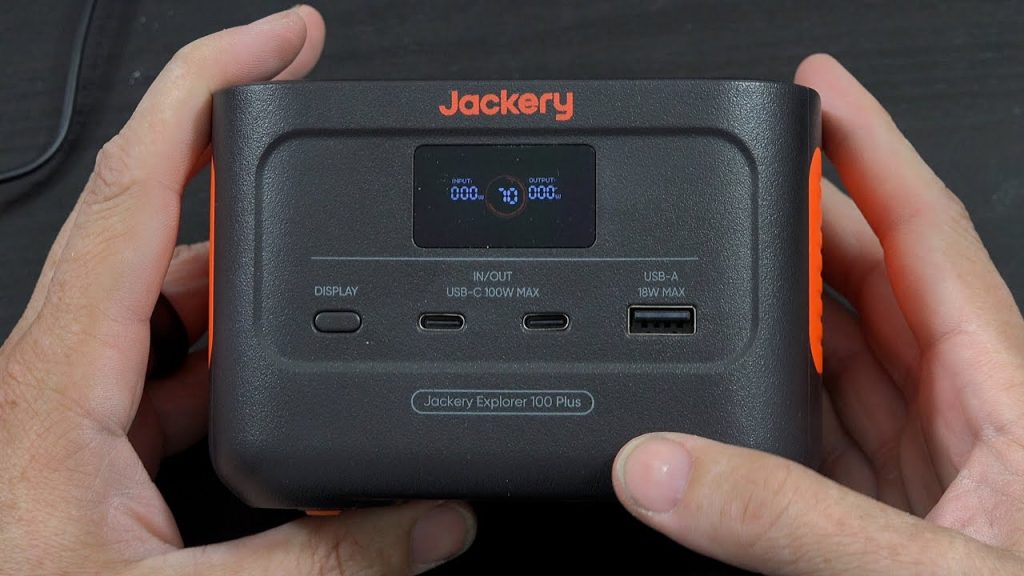
The Explorer 100 Plus is compact and easy to carry. It has a built-in handle on top. The weight of 2.9 lbs is light enough to carry in one hand for extended periods. The case is made of sturdy plastic with rubberised corners to absorb impacts. The control panel faces upward, with the AC outlet, USB ports, car port and display screen all accessible from the top.
The display shows:
- Battery level (percentage and bar graph).
- Input wattage (when charging).
- Output wattage (when powering devices).
- Temperature warnings (if overheating).
The unit is airline‑approved for carry-on luggage because the battery capacity is under 100 Wh. You should check with your specific airline before flying.
What Can The Jackery Explorer 100 Plus Power?
The 99 Wh battery is small. It is designed for low‑power devices and short runtimes. The table below provides approximate runtimes for common devices.
| Device | Power Draw | Estimated Runtime (on full battery) |
|---|---|---|
| Smartphone (iPhone 17) | 5‑10W | 8‑15 charges |
| Tablet (iPad) | 10‑20W | 4‑8 charges |
| Laptop (MacBook Air) | 30‑60W | 1.5‑3 hours |
| Drone (DJI Mavic) | 30‑50W | 2‑3 charges |
| CPAP Machine (without humidifier) | 30‑60W | 1.5‑3 hours |
| Mini Fridge (12V, 40W) | 40W | 2‑3 hours |
| LED Camping Light | 5‑10W | 10‑20 hours |
The AC outlet is limited to 100W. It cannot power high‑draw devices such as hair dryers (1,500W), electric kettles (800‑1,500W) or space heaters (1,500W). Attempting to draw more than 100W will trigger the overload protection and shut off the outlet.
Charging Methods And Speed
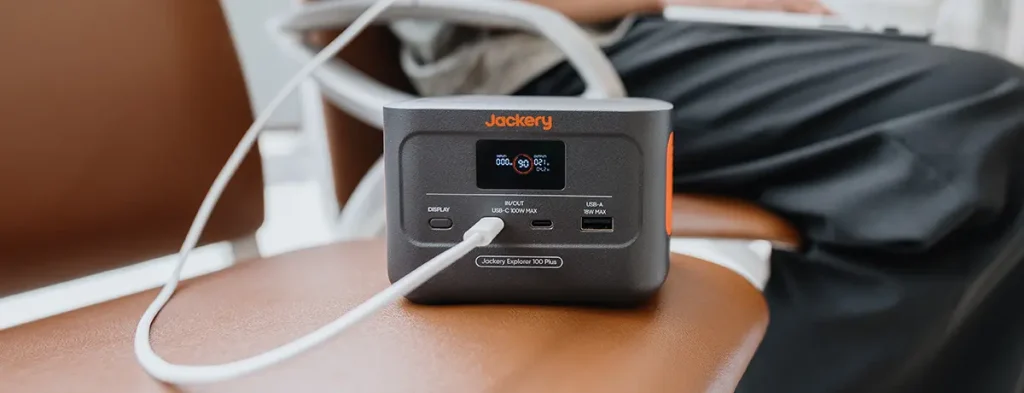
The Explorer 100 Plus can be recharged in three ways.
Wall outlet (AC)
Using the included 65W AC adapter, a full charge takes approximately 2 hours. The unit supports pass‑through charging, so you can power devices while the battery is charging.
Car socket (12V)
Using the included car charging cable, a full charge takes approximately 2.5 hours. This is convenient for road trips.
Solar panel (100W max)
The unit can be charged with Jackery‘s SolarSaga series panels (sold separately). A 100W panel in direct sunlight will fully charge the Explorer 100 Plus in approximately 2.5 hours. The unit has a built‑in MPPT (Maximum Power Point Tracking) charge controller, which optimises solar charging efficiency.
Jackery Explorer 100 Plus Vs Competitors
| Aspect | Jackery Explorer 100 Plus | Goal Zero Yeti 200X | Anker PowerHouse 521 |
|---|---|---|---|
| Capacity | 99 Wh | 187 Wh | 128 Wh |
| Weight | 2.9 lbs | 5.4 lbs | 3.5 lbs |
| AC Outlets | 1 (100W) | 1 (120W) | 1 (200W) |
| USB‑C Ports | 1 (60W) | 1 (60W) | 1 (60W) |
| USB‑A Ports | 2 (12W each) | 2 (12W each) | 2 (12W each) |
| Car Port | Yes (96W) | Yes | Yes |
| Battery Chemistry | NMC (Li‑ion) | LiFePO4 | LiFePO4 |
| Cycle Life | ~500 cycles | ~2,000 cycles | ~2,000 cycles |
| Solar Input | 100W | 100W | 100W |
| Price | $129‑159 | $250‑300 | $160‑200 |
| Best For | Lightweight, airline‑approved travel | Longer runtime, longer lifespan | Balanced capacity and lifespan |
The Jackery Explorer 100 Plus is the lightest and most affordable. The Goal Zero Yeti 200X has nearly twice the capacity but is heavier and more expensive. The Anker PowerHouse 521 offers a middle ground with LiFePO4 chemistry for longer cycle life.
Pros And Cons Of The Jackery Explorer 100 Plus
Pros
- Very lightweight (2.9 lbs) and compact.
- Under 100 Wh, so it is allowed in carry-on luggage on most airlines.
- 100W AC outlet can charge small laptops, drones and CPAP machines.
- 60W USB‑C Power Delivery port for fast charging of phones and tablets.
- Pass‑through charging allows you to use the unit while it recharges.
- Quiet operation (no cooling fan noise).
- MPPT solar charge controller for efficient solar charging.
- Clear display shows battery percentage, input and output wattage.
- Includes AC charger and car charger in the box.
- 2‑year warranty (extendable to 3 years).
Cons
- Low capacity (99 Wh) is not suitable for large appliances or extended off‑grid stays.
- 100W AC output cannot power hair dryers, kettles or space heaters.
- NMC battery chemistry has a shorter cycle life (500 cycles) than LiFePO4 (2,000+ cycles).
- Solar panel is sold separately (adds approximately 100‑150 USD to the cost).
- No wireless charging pad (some competitors include this).
- The AC outlet is non‑grounded (2‑prong only).
- The display does not show estimated time remaining (only percentage and wattage).
- Pass‑through charging can generate heat; avoid using it in direct sunlight.
Frequently Asked Questions (FAQs)
Can I take the Jackery Explorer 100 Plus on an airplane?
Yes. Most airlines allow batteries under 100 Wh in carry‑on luggage. The Explorer 100 Plus is rated at 99 Wh, so it is within the limit. You cannot check it in hold luggage. Always confirm with your specific airline before travelling.
How long does it take to charge the Explorer 100 Plus from a wall outlet?
Approximately 2 hours using the included 65W AC adapter.