



Table of Contents
Introduction
Dancing Disc is a brand that was born from a parent’s fear. Founder Glen Gomez watched his daughter, Bailey, nearly injure herself during a turning practice session, and decided that the standard turning boards on the market were not safe enough. The result is a portable practice disc topped with the same Marley vinyl used in professional dance studios, designed to give dancers a realistic turning surface at home without the slip risk of cheaper plastic boards. The brand has since been featured on Fox40 News, launched an Etsy storefront that has already made over 250 sales with a 5-star rating, and built a small but loyal following among ballet and tap families.
But a product born from a safety mission is not automatically the right purchase for every dancer. The Dancing Disc is priced at a premium, it is sold primarily through a single brand website and Etsy shop, and the independent review footprint is still thin. This review separates the genuine safety and material advantages from the pricing and transparency questions so you can decide whether Dancing Disc is worth the investment for your practice routine.
What Is Dancing Disc?
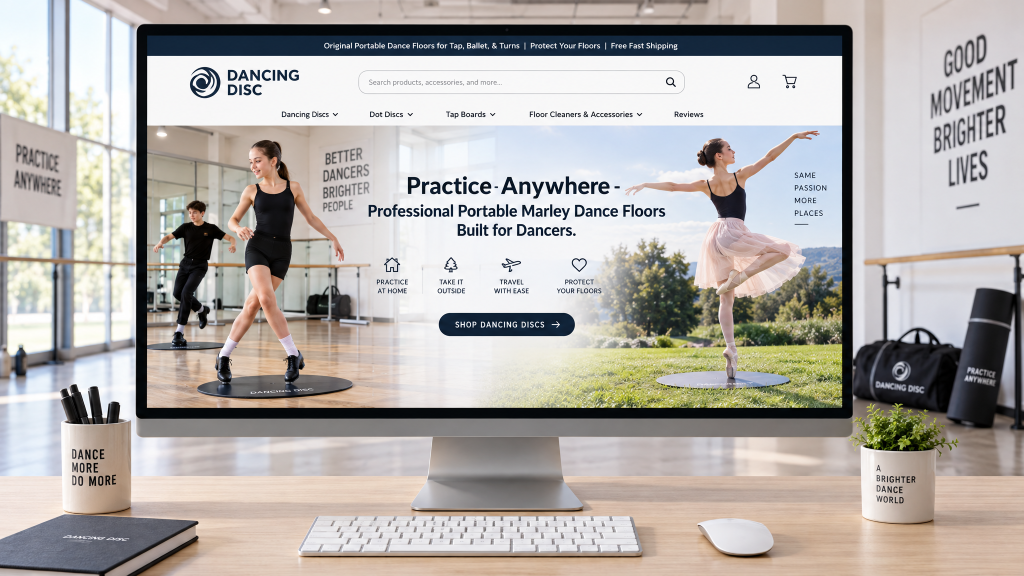
Dancing Disc is a US-based company that designs and sells portable turning boards and practice floors for dancers. The brand is headquartered in Los Alamitos, California, and the business is family-run, with founder Glen Gomez and his daughter Bailey both involved in the product’s development and community storytelling.
Key aspects of the brand include:
- Founded by a dance parent after a near-injury incident, with a mission centred on safer turning practice
- Product focus: portable turning discs topped with real Marley vinyl, the same surface used in professional studios and competitions
- Three sizes: 16-inch, 24-inch, and 30-inch discs, with the 30-inch model positioned for beginners and tap dancers who need more room
- Non-slip rubber base designed to grip wood, tile, and laminate floors without sliding
- Seatbelt-style carry handle for portability to and from class
- 30-day money-back guarantee with a published refund policy
- Shipped to 25+ countries from US warehouses
- A charitable edition: the Pink Handle Edition donates $15–$20 per disc to Dancers Against Cancer
The brand’s identity is built on safety and studio authenticity rather than on low price or mass-market availability.
The Product Line: Three Sizes, One Purpose
Dancing Disc’s catalogue is deliberately narrow. The brand sells one core product in three sizes, plus a charitable colourway, and it does not try to be a one-stop dance shop.
The 16-Inch Disc is the smallest and most portable option. It is positioned for advanced dancers who want a greater challenge and for travel, since it fits easily into a dance bag.
The 24-Inch Disc is the versatile middle size. It is described by the brand as suitable for most dancers and is the safest all-round choice for teenagers and adults who want enough room to complete multiple rotations without the disc being too large to store.
The 30-Inch Disc is the largest and most stable option. It is recommended for beginners and tap dancers, because the extra surface area gives more room for footwork and reduces the risk of stepping off the edge during a turn.
The Pink Handle Edition is the same disc with a pink seatbelt-style handle, and the brand donates $15 (24-inch) or $20 (30-inch) to Dancers Against Cancer at no extra cost to the buyer.
| Model | Size | Best For | Key Detail |
|---|---|---|---|
| The Disc (Small) | 16″ | Advanced dancers, travel | Most portable |
| The Disc (Medium) | 24″ | Most dancers, versatile | The all-rounder |
| The Disc (Large) | 30″ | Beginners, tap dancers | Most room to move |
| Pink Handle Edition | 24″ / 30″ | Gift buyers, charity supporters | $15–$20 donated per disc |
Materials and Build Quality
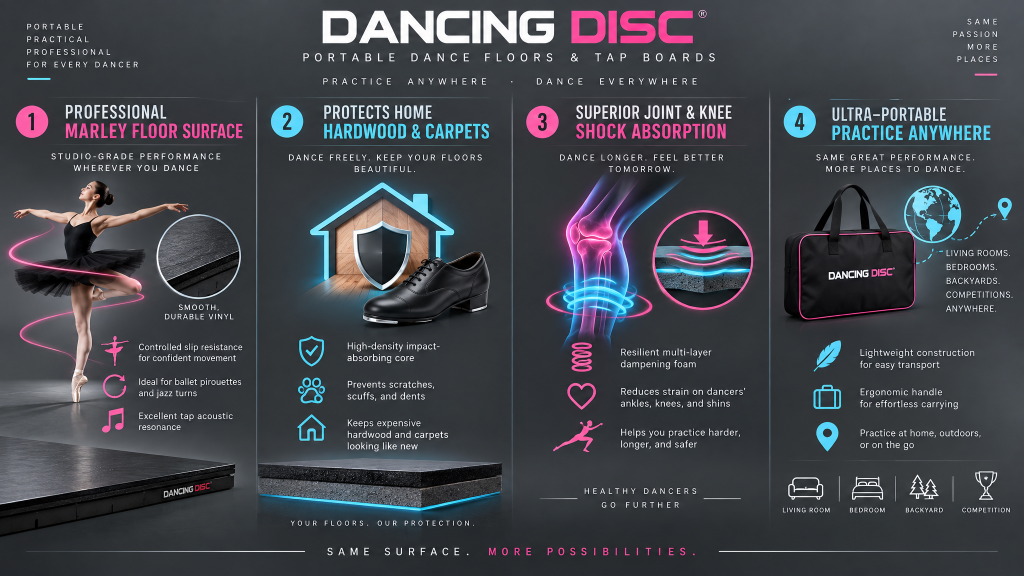
Build quality is where Dancing Disc makes its most credible claim, and the material specification is a genuine differentiator in a market dominated by cheap plastic.
What the brand and owners highlight:
- Real Marley vinyl surface: The disc is topped with the same controlled-slip vinyl used in professional dance studios and competitions. This is the core selling point, because it gives dancers a familiar feel and predictable grip rather than the unpredictable slickness of bare plastic.
- Non-slip rubber base: The underside is designed to grip wood, tile, and laminate, which addresses the most common complaint about cheaper turning boards: they slide across the floor when you spin.
- Tapered edge: The edge is shaped to reduce tripping hazards, which is a meaningful safety detail for beginners and younger dancers.
- Seatbelt-style handle: The handle is sturdy enough to carry the disc like a bag, and it is stitched rather than glued, which is a durability signal.
Where the build quality claims need scrutiny:
- The Marley surface is a consumable. It will wear over time with heavy use, especially if the disc is used on rough or dirty floors, and the brand does not publish a replacement surface programme.
- The independent review record is still thin. Most positive feedback comes from the brand’s own website, Etsy store, and press releases, not from long-term independent testing.
- A similar category of product has drawn complaints about the plastic bottom scratching easily and the material feeling lightweight for the price, which is a reminder that “studio material” on top does not guarantee premium construction throughout.
| Component | Feedback |
|---|---|
| Marley surface | Genuine studio material, controlled slip |
| Rubber base | Grips hard floors well |
| Tapered edge | Safety-focused design detail |
| Handle | Stitched and sturdy |
| Longevity | Surface is a wear item; long-term data is limited |
Design and Real-World Experience
The design is practical and focused on the specific use case of turning practice, and it does not pretend to be a full dance floor.
What works well:
- The size range covers the main use cases: a small disc for travel and advanced practice, a medium disc for most dancers, and a large disc for beginners and tap.
- The portability is a genuine advantage over a full Marley floor. The disc can go to class, to a friend’s house, or into a small apartment where a permanent dance floor is not possible.
- The safety focus is consistent across the design: the rubber base prevents sliding, the tapered edge reduces tripping, and the Marley surface gives predictable grip.
- The charity edition is a thoughtful detail that gives buyers a reason to choose the brand beyond the product itself.
Where the design does not work for everyone:
- It is a one-foot spot for drilling, not a studio floor. Dancers who want to run combinations or practice travelling movement will need more space.
- The 30-inch disc is large enough to be awkward in small apartments, and it is not as easy to store as the 16-inch version.
- The price is high relative to generic turning boards, and the value depends on whether the Marley surface and safety design matter enough to justify the premium.
Performance: Does It Deliver?
Performance is where Dancing Disc is strongest for its intended use case, and the feedback from dancers and parents is largely positive.
What the brand and owners report:
- The Marley surface provides a realistic turning feel, which helps dancers transfer what they practise at home to the studio floor.
- The non-slip base keeps the disc in place, which is the single biggest safety improvement over cheaper boards that slide mid-turn.
- Parents describe the disc as a way to increase practice frequency without a studio visit, which is the core value proposition for busy families.
- The Etsy storefront holds a 5-star rating across 250+ sales, which is a meaningful signal for a small brand, even if the sample size is modest.
Where performance expectations should be tempered:
- A turning disc does not replace strength work. It trains balance and spotting, but it will not build the ankle and core strength that a full practice routine requires.
- The surface is not a competition floor. It is a practice aid, and the brand itself describes it as a one-foot drilling spot rather than a full studio replacement.
- The long-term durability of the Marley surface is not independently documented, so buyers should expect to replace the disc eventually if they use it daily.
| Performance Aspect | Feedback |
|---|---|
| Turning feel | Realistic — Marley surface is the key advantage |
| Stability | Strong — rubber base grips hard floors |
| Safety | Good — tapered edge and controlled slip |
| Practice value | High for drilling turns, limited for full combinations |
| Longevity | Surface is a wear item; data is limited |
Pricing and Value
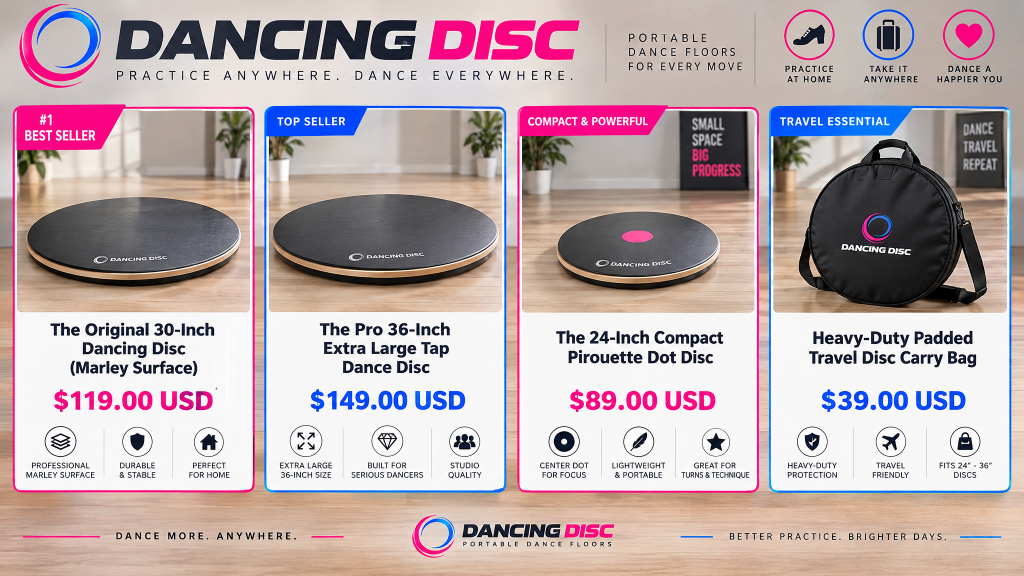
Dancing Disc is priced at a premium for the turning-board category, and the value case depends entirely on whether the Marley surface and safety design are worth the extra cost.
Typical pricing:
- 16-inch disc: the lowest price point in the range, positioned for travel and advanced dancers
- 24-inch disc: the mid-range option and the most popular size
- 30-inch disc: the highest price in the standard range, with more surface area
- Pink Handle Edition: same price as the standard disc, with a charitable donation included
- Shipping: US economy from $14**, standard from **$17, express from $49, with international rates calculated at checkout
| Product | Price Positioning | Value Assessment |
|---|---|---|
| 16″ Disc | Premium vs. generic boards | Fair if portability and Marley matter |
| 24″ Disc | Premium | The best all-round value for most dancers |
| 30″ Disc | Premium | Fair for beginners and tap dancers |
| Pink Handle Edition | Same as standard | Strong if you value the charity component |
The value case is strongest for families who will use the disc regularly and for dancers who specifically need a Marley surface to replicate studio conditions. It is weaker for casual buyers who just want a cheap turning board to try out, because generic boards cost a fraction of the price even if they do not offer the same safety and surface quality.
Customer Experience: The Review Footprint Question
This is the part of the Dancing Disc story that any honest review must confront directly. The brand is responsive and the published policies are clear, but the independent review record is still limited.
Positive signals:
- The 30-day money-back guarantee is clearly published, with returns handled by email at orders@dancingdisc.com and a US return address in Long Beach, California.
- The Etsy storefront has a 5-star rating across 250+ sales, which is a meaningful independent signal, even if the volume is modest.
- The brand has been featured on Fox40 News and covered by news release outlets, which adds a layer of legitimacy beyond its own marketing.
- The charity edition includes a published donation promise with a per-disc amount and no cap, which is more transparent than most cause-marketing campaigns.
Where the experience is less clear:
- There is no substantive Trustpilot presence for Dancing Disc that would provide an aggregated, independent view of customer satisfaction.
- The return policy excludes sale items and gift cards, and the buyer is responsible for return shipping in some cases, which is standard but worth knowing.
- The long-term durability of the Marley surface is not independently reviewed, so buyers are relying on the brand’s own claims for a product that is designed to be used repeatedly.
| Platform | Rating / Feedback |
|---|---|
| Brand website | Positive testimonials, but brand-hosted |
| Etsy (OriginalDancingDisc) | 5-star rating, 250+ sales |
| News coverage | Fox40 feature and press releases |
| Trustpilot | No substantive presence found |
| Common praise | Safety, Marley surface, portability |
| Common questions | Long-term durability, price vs. generic boards |
Pros and Cons
| Pros | Cons |
|---|---|
| Real Marley surface for studio-like turning feel | Premium price vs. generic turning boards |
| Non-slip rubber base keeps the disc stable | Limited independent long-term durability data |
| Tapered edge and controlled slip improve safety | Marley surface is a wear item with no replacement programme |
| Three sizes for different levels and use cases | Large 30-inch disc is awkward in small spaces |
| Seatbelt-style handle makes it portable | No substantive Trustpilot presence |
| 30-day money-back guarantee published | Sale items excluded from returns |
| Charity edition donates to Dancers Against Cancer | Review footprint is still small |
Dancing Disc vs. Standard Turning Boards
How does Dancing Disc compare to generic turning boards and other named brands?
| Feature | Dancing Disc | Generic Plastic Turn Board | Name-Brand Turn Disc (e.g., TTolbi) |
|---|---|---|---|
| Surface | Real Marley vinyl | Smooth plastic | Varies, often plastic or synthetic |
| Base | Non-slip rubber | Often smooth or lightly textured | Varies |
| Safety Design | Tapered edge, controlled slip | Minimal | Varies |
| Sizes | 16″, 24″, 30″ | Usually one size | Usually one size |
| Portability | Handle included | Carry bag sometimes | Varies |
| Price | Premium | Budget | Mid-range |
| Return Policy | 30-day money-back | Varies by seller | Varies |
| Best For | Dancers who want studio feel and safety | Casual trial | Budget-conscious dancers |
Dancing Disc’s advantage is the Marley surface and safety-focused design. Generic boards are cheaper but slippery and less stable, and most named competitors do not match the studio-material specification. For a dancer who practises regularly and wants a safer, more realistic turning experience, Dancing Disc is a compelling option. For a casual buyer who just wants to try a turning board, the price is harder to justify.
Verdict and Final Thoughts
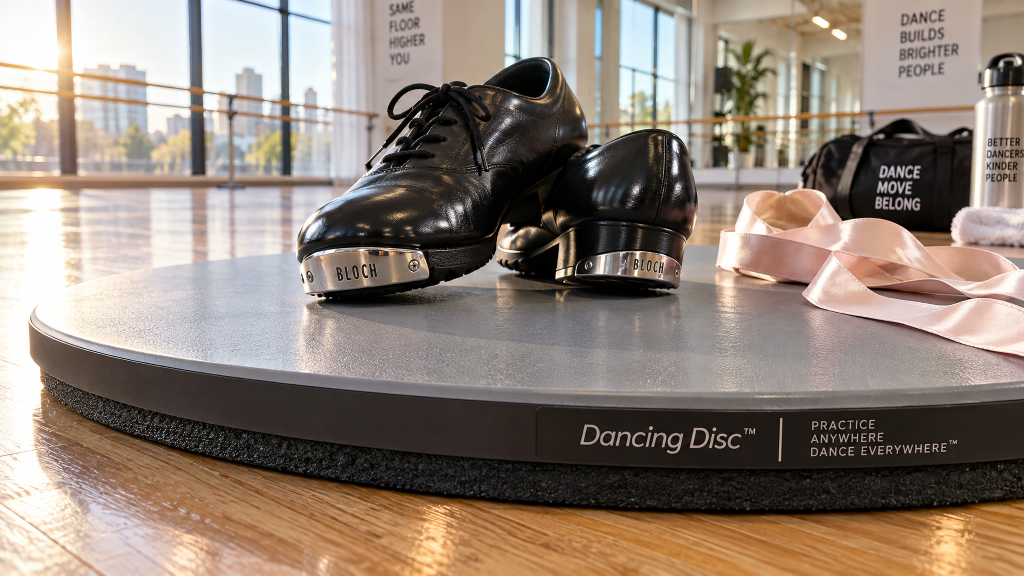
Dancing Disc is a brand with a genuine origin story and a product that solves a real safety problem. The Marley surface gives dancers a realistic feel that generic boards cannot match, the non-slip base and tapered edge are meaningful safety improvements, and the 30-day money-back guarantee gives buyers a reasonable safety net. For families who will use the disc regularly and want their dancer to practise in a safer, more studio-like environment, it is a thoughtful purchase.
But the product is not for everyone. The price is premium, the independent review footprint is still thin, and the Marley surface is a wear item that will eventually need replacing. The brand’s charity edition is a nice touch, but it does not change the core value calculation: you are paying for a specific material and safety design, not for a budget turning board.
Who is Dancing Disc best for?
- Dance parents who want a safer practice option for their child at home
- Dancers who want a Marley surface to replicate studio conditions
- Tap dancers who need a larger, more stable practice surface
- Buyers who value a family-run brand with a published safety mission and a charity component
Who should look elsewhere?
- Casual buyers who just want to try a turning board without a premium outlay
- Dancers who need a full practice floor rather than a one-foot drilling spot
- Budget shoppers who are comfortable with a generic plastic board and its limitations
- Anyone who needs independent long-term durability data before buying
Overall, Dancing Disc is worth considering if you fit the use case and value the Marley surface and safety design. The product is well-conceived, the brand is transparent about its mission, and the return policy is fair. For the right buyer, the investment is justified. For everyone else, a cheaper generic board may be sufficient.
Considering Dancing Disc? Choose the 24-inch size for most dancers, the 30-inch for beginners and tap, and the 16-inch for travel. Confirm the return policy for your country before ordering.
Scorecard
| Category | Rating |
|---|---|
| Design & Safety | ⭐⭐⭐⭐½ |
| Material Quality (Marley Surface) | ⭐⭐⭐⭐½ |
| Build Quality & Durability | ⭐⭐⭐½ |
| Pricing & Value | ⭐⭐⭐⭐⭐ |
| Customer Experience & Transparency | ⭐⭐⭐½ |
| Overall Rating | 4.4/5 |