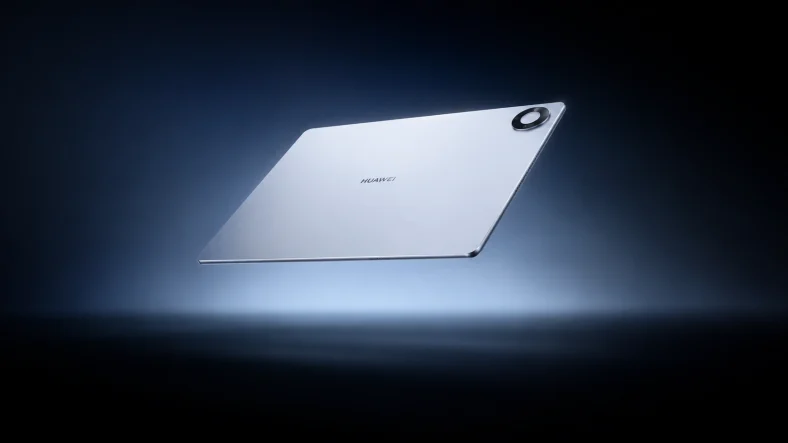
Huawei has unveiled the MatePad Pro Max, a tablet that pushes the boundaries of industrial design. At just 4.7mm thick and starting at 499 grams, it claims the title of the world’s thinnest large-format tablet. The device was launched at a global event in Bangkok on May 7, 2026, alongside other products like the nova 15 Max and WATCH FIT 5 series. This review covers its design, display, performance, battery life, pricing, and the significant caveat that comes with its software.
Key Specifications Of The MatePad Pro Max
The MatePad Pro Max is a premium tablet designed to compete with the iPad Pro, the Samsung Galaxy Tab S11 Ultra, and the Honor MagicPad 4. The table below summarizes its core specifications based on official product listings and expert reviews.
| Feature | Specification |
|---|---|
| Dimensions | 289.34 x 196.34 x 4.7 mm |
| Weight | 499 grams (standard) / 509 grams (PaperMatte Edition) |
| Display | 13.2 inch Flexible OLED, 3,000 x 2,000 pixels (273 ppi) |
| Refresh Rate | 144 Hz |
| Peak Brightness | 1,600 nits |
| Screen-to-Body Ratio | 94 percent |
| Bezel Width | 3.55 mm |
| Processor | Kirin 9 series (Huawei claims 20% faster than previous generation) |
| RAM | 12 GB / 16 GB |
| Storage | 256 GB / 512 GB |
| Rear Camera | 50 MP (f/1.8, autofocus) |
| Front Camera | 12 MP (f/2.4, hidden in bezel) |
| Audio | 6 speakers with Huawei Sound, 4 microphones |
| Battery | 10,400 mAh (global) / 9,760 mAh (EU) |
| Charging | 66W wired fast charging, 40W wired reverse charging |
| Wireless | Wi-Fi 7, Bluetooth 6.0, NearLink (StarFlash) |
| Ports | USB-C 3.1 |
| Operating System | HarmonyOS 4.3 (with AOSP 12) |
| Colors | Blue, Space Gray |
Design And Build Quality: Unbelievably Thin And Light
The headline feature of the MatePad Pro Max is its astonishingly slim profile. At just 4.7mm, it is thinner than the Honor MagicPad 4 (4.8mm), the 13 inch iPad Pro (5.1mm), and the Samsung Galaxy Tab S11 Ultra (5.1mm). This makes it the current record holder for the world’s thinnest tablet. The standard model weighs only 499 grams, making it lighter than the iPad Pro (579g) and the Galaxy Tab S11 Ultra (692g). The PaperMatte edition is slightly heavier at 509 grams.
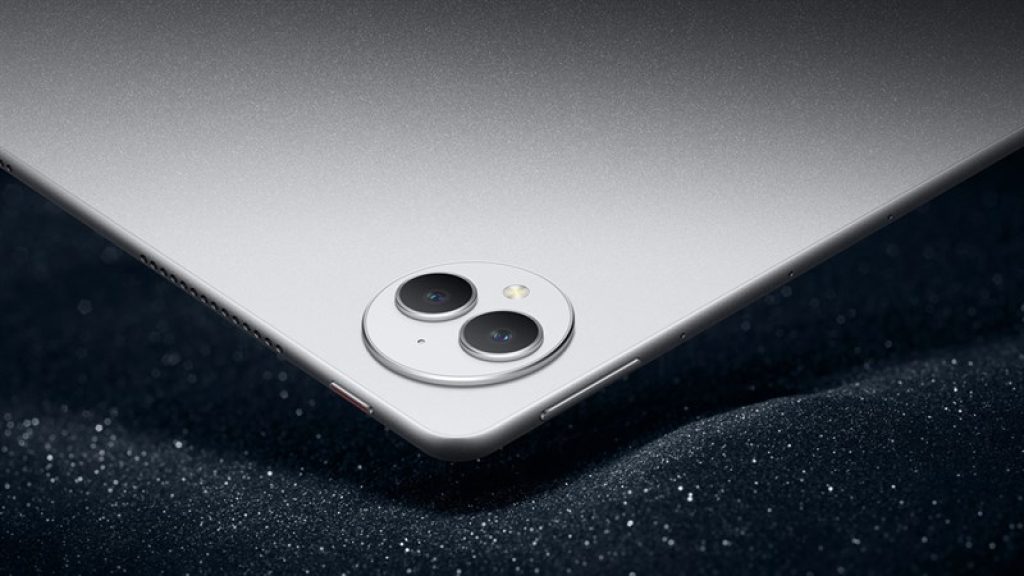
Despite its wafer-thin chassis, Huawei has built the MatePad Pro Max to be durable. It uses a metal unibody design with an internal load-bearing beam structure and reinforced points for the camera, mainboard, and battery. The tablet is the first to pass the TÜV Rheinland Ultra-thin Bending Resistance Certification. Early hands-on reviews confirm that the tablet feels solid and does not flex under normal pressure. The camera island on the back protrudes slightly, but the rest of the body is remarkably thin.
The tablet comes in two colors: Blue and Space Gray. The Blue variant has a matte texture that feels good to hold and visually stands out. The design is completed by a round camera module on the back, reminiscent of the Huawei Mate series smartphones.
Display: A Clear Standout Feature
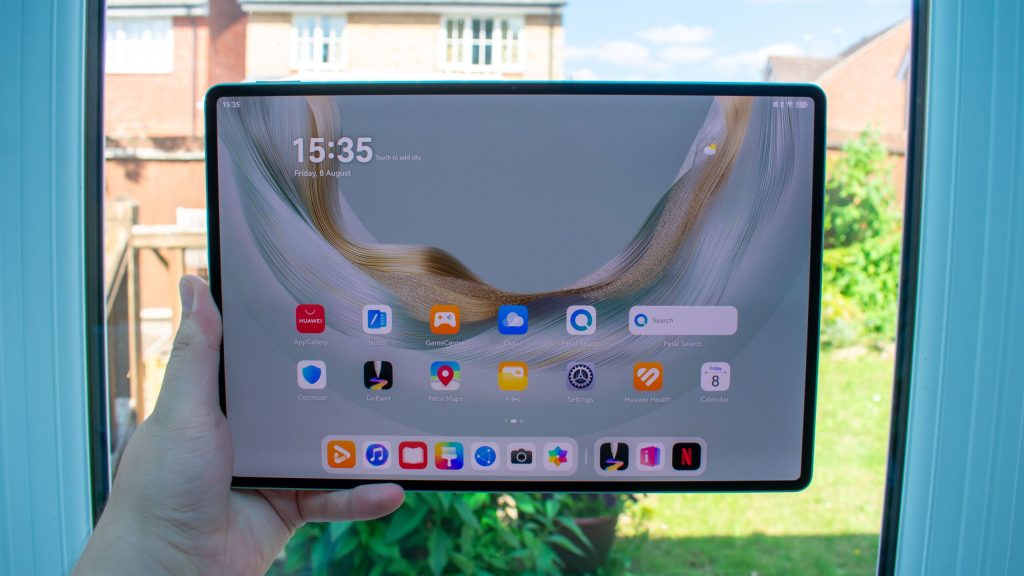
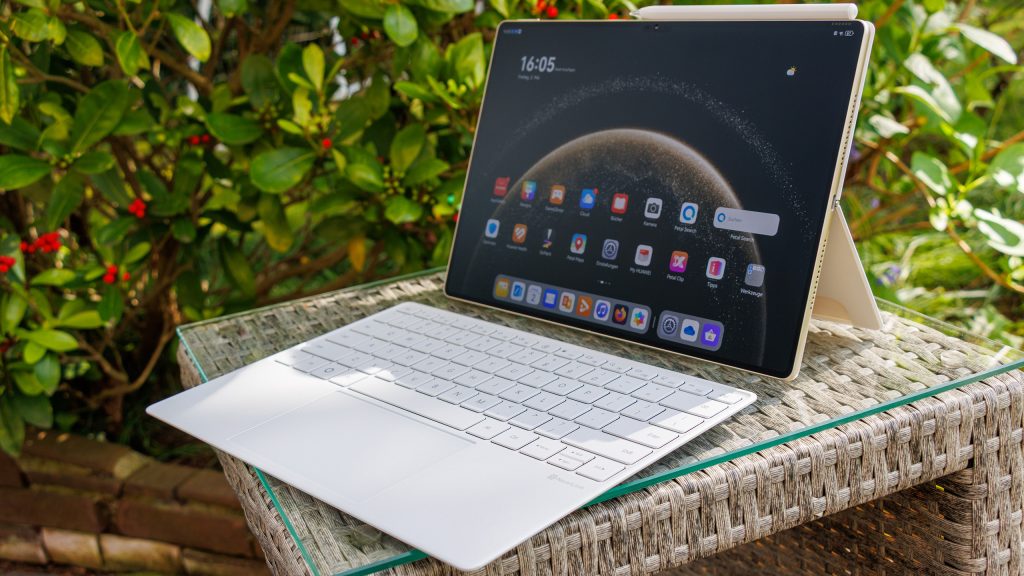
The 13.2 inch flexible OLED display is one of the strongest features of the MatePad Pro Max. It has a sharp 3,000 by 2,000 pixel resolution and a silky smooth 144Hz refresh rate. The peak brightness of 1,600 nits is exceptionally high for a tablet, making the screen easily readable even outdoors under direct sunlight. The contrast ratio is listed at 2,000,000 to 1, delivering deep blacks and vibrant colors.
The screen-to-body ratio is an impressive 94 percent, achieved by reducing the bezels to just 3.55mm. The front 12MP camera is hidden within this slim bezel, eliminating the need for a notch or a punch-hole cutout, which results in a truly uninterrupted viewing experience.
Reviewers have praised the Panel, noting that it gets bright enough and that the color vibrancy is a significant improvement over previous models. There is also a PaperMatte edition available. This version uses high-precision nano-level etching to minimize glare and sparkle, making it feel more like paper when writing with the stylus. It also carries a reading certification for eye comfort.
Performance And Cooling
Huawei has not officially named the chipset inside the MatePad Pro Max, but leaks and reports point to a new Kirin 9 series processor. The company claims that the tablet is 20 percent faster than the previous MatePad Pro and that its thermal management has been improved by 30 percent.
To sustain peak performance, Huawei has redesigned the internal layout with a centralized mainboard. The cooling system includes a dual-layer VC (vapor chamber) structure and innovative thermal materials, resulting in a 100 percent larger heat dissipation area compared to last year’s model. This allows the tablet to handle demanding workloads without significant throttling. The tablet comes with 12GB or 16GB of RAM and 256GB or 512GB of storage.
Battery Life And Charging
The MatePad Pro Max packs a large 10,400 mAh battery, which shrinks to 9,760 mAh in the European Union due to local regulations. Huawei claims that this battery can deliver up to 14.5 hours of local video playback on a single charge.
When it comes to charging, the tablet supports 66W wired SuperCharge. It can also act as a power bank, offering 40W wired reverse charging to top up other devices like phones or earbuds. In the EU, the tablet is sold without a charger in the box, while other regions include a 100W power adapter.
Audio And Cameras
Audio is handled by a six-speaker system tuned by Huawei Sound. It includes four microphones for clear voice calls. Reviews note that the six-speaker system, which includes a quad-driver bass unit, makes the tablet a complete media consumption powerhouse.
The tablet features a 50MP rear camera with an f/1.8 aperture, which is a higher resolution sensor than what Apple has ever put in an iPad Pro. A round camera module on the back houses this sensor. There is also a 12MP front camera cleverly integrated into the narrow bezel.
Software And The Missing Google Services
The MatePad Pro Max runs on HarmonyOS 4.3, which is based on Android 12 through the Android Open Source Project (AOSP). The software supports PC-level multitasking with the Live-Multitask feature, allowing users to run three windows simultaneously. It includes AI features such as handwriting enhancement, equation calculation, and a GoPaint app with over 150 brushes for digital artists.
The significant trade-off is the lack of Google Mobile Services. This means there is no Google Play Store, and users cannot natively access Google apps such as Gmail, YouTube, Google Maps, or the Chrome browser. Huawei has been building its own AppGallery as an alternative, but its app selection is much more limited. Outside of China, this remains the central barrier for anyone considering this tablet. Users can explore unofficial workarounds to run Android apps, but the experience is not seamless.
MatePad Pro Max Vs IPad Pro 13 Vs Galaxy Tab S11 Ultra
The MatePad Pro Max directly competes with other premium tablets. The table below summarizes how it compares to its main rivals.
| Aspect | Huawei MatePad Pro Max | Apple iPad Pro 13 | Samsung Galaxy Tab S11 Ultra |
|---|---|---|---|
| Thickness | 4.7 mm | 5.1 mm | 5.1 mm |
| Weight | 499 g | 579 g | 692 g |
| Display | 13.2 inch OLED, 144 Hz, 1,600 nits | 13 inch OLED, 60Hz (refresh rate varies by model) | AMOLED |
| Processor | Kirin 9 series | Apple M5 | Snapdragon 8 Gen 4 |
| Rear Camera | 50 MP | 12 MP | Dual camera |
| Battery | 10,400 mAh | Approximately 10,000 mAh | Approximately 10,000 mAh |
| Fast Charging | 66W | 30W+ (varies) | 45W |
| Software | HarmonyOS 4.3 | iPadOS | Android 16 with One UI |
| Starting Price (approx) | 999 GBP / 1,399 EUR | Higher | Higher |
Pricing And Availability
The MatePad Pro Max launched globally but with significant regional variations. In the United Kingdom, the starting price is 999.99 British Pounds for the 12GB RAM and 256GB storage model. In the Eurozone, pricing is structured differently. The 12GB + 512GB PaperMatte edition with a Folio Cover is priced at 1,399 Euros. The 12GB + 256GB model with the Smart Keyboard costs 1,499 Euros, and the top-tier 16GB + 512GB version with the Smart Keyboard is 1,649 Euros. The Glide Keyboard is sold separately for 299 Euros.
Crucially, the tablet is not officially sold in the United States due to ongoing trade restrictions. Potential buyers in other regions should check local availability.
Pros And Cons Of The Huawei MatePad Pro Max
Pros
- World’s thinnest and one of the lightest 13 inch tablets available.
- Stunning 13.2 inch 3K OLED display with a 144Hz refresh rate and an impressive 94 percent screen-to-body ratio.
- Premium metal unibody design with a durable build and TÜV certification for bending resistance.
- Large 10,400 mAh battery with 66W fast charging and useful 40W reverse charging.
- High-resolution 50MP rear camera and a cleverly hidden 12MP front camera.
- Six-speaker system with Huawei Sound for an immersive audio experience.
- Improved performance and cooling system with a dual-layer VC structure.
- PC-level multitasking with the ability to run three windows simultaneously.
- PaperMatte edition offers an anti-glare display that feels like paper for writing.
Cons
- No Google Mobile Services, meaning no Google Play Store and no native access to Google apps.
- High starting price in premium tablet territory.
- Processor performance likely lags behind the Apple M5 chip found in the iPad Pro.
- Software ecosystem is a major hurdle for users outside of Huawei’s existing user base.
- Availability is limited, with no official sales in the United States.
- Battery capacity is reduced to 9,760 mAh in the EU, and the charger is not included.
- The camera island protrudes slightly from the otherwise flat back.
Frequently Asked Questions (FAQs)
What is the price of the Huawei MatePad Pro Max?
The tablet starts at 999.99 British Pounds in the UK for the 12GB/256GB model. In the Eurozone, prices range from 1,399 Euros to 1,649 Euros depending on the configuration and bundled accessories.
Is the Huawei MatePad Pro Max available in the United States?
No. Due to ongoing US trade restrictions, Huawei products are not officially sold in the United States. They can sometimes be found through third-party sellers or importers.