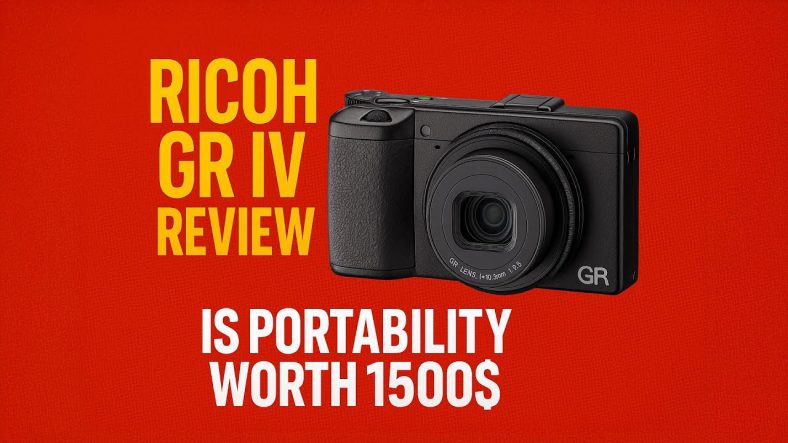
The RICOH GR IV is the long‑awaited successor to the GR III, arriving six years later with a significant price increase but also substantial internal upgrades. While it retains the iconic minimalist body loved by street photographers, the camera now packs a 25.7MP BSI CMOS sensor, a redesigned 28mm f/2.8 lens, 5‑axis in‑body image stabilization, the brand‑new GR Engine 7 processor, and 53GB of internal storage. The base model starts at 1,500 USD, representing a 600 USD jump over the GR III’s launch price. This review covers design changes, performance improvements, image quality, and how the GR IV compares to the older GR IIIx and the specialty Monochrome version, which trades color for a dedicated black‑and‑white sensor and a built‑in optical red filter.
Key Specifications Of The Ricoh GR IV
| Feature | Specification |
|---|---|
| Sensor | 25.7MP (approx. 26MP) APS‑C BSI CMOS |
| Processor | GR Engine 7 |
| Lens | 18.3mm f/2.8 (28mm full‑frame equiv.) / redesigned with 7 elements in 5 groups |
| Stabilization | 5‑axis sensor‑shift (up to 6 stops) |
| ISO Range | 100 – 204,800 (expandable) |
| Autofocus | Phase detection + contrast; face/eye detection |
| Shutter | 1/4000 (mech) / 1/16000 (elec) |
| Continuous Shooting | Approx. 4 fps |
| Internal Storage | 53GB |
| Media | MicroSD slot (UHS‑I) |
| Viewfinder | None (no external EVF option) |
| Screen | 3.0‑inch fixed touchscreen LCD, 1,037k dots |
| Video | 1080p at up to 60 fps |
| Wireless | Bluetooth, Wi‑Fi (2.5/5GHz) |
| Battery | DB‑120, approx. 250 shots |
| Dimensions | 109.4 x 61.1 x 32.7 mm (slightly thinner than GR III) |
| Weight | 262g (approx. 9.2 oz) |
| Available Colors | Standard black |
Design And Build: Small Refinements, Same Pocketability
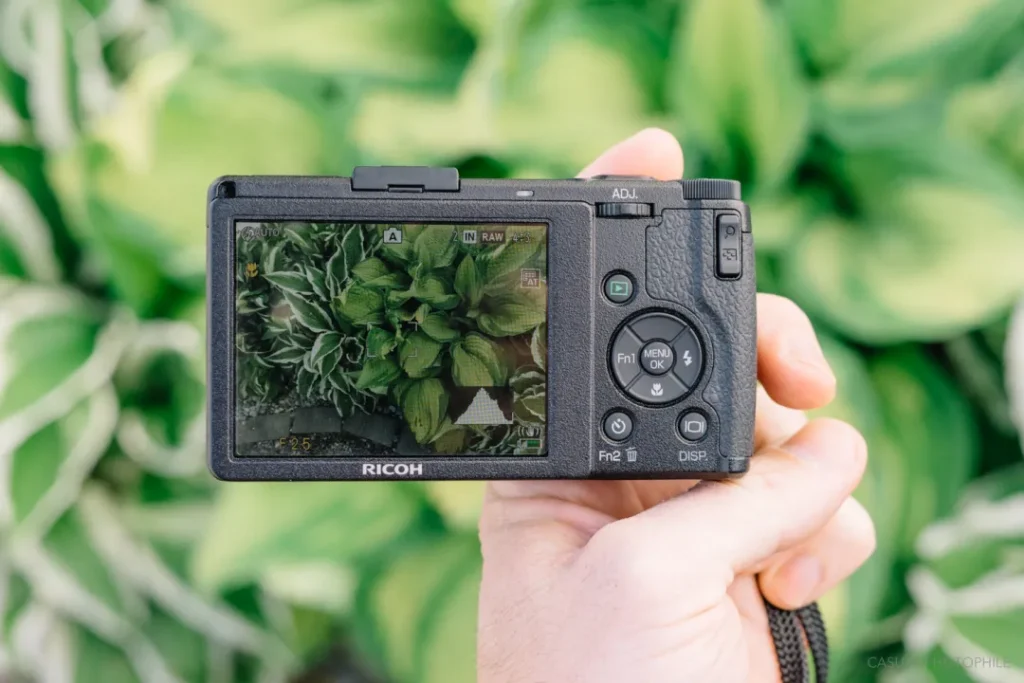
The GR IV looks nearly identical to its predecessor, but Ricoh has made several subtle ergonomic improvements based on user feedback. The camera is slightly slimmer and narrower than the GR III, with a more pronounced grip texture for better single‑handed operation. The old scroll wheel is gone, replaced by a tactile D‑pad. There is also a new plus/minus rocker for exposure compensation, a feature borrowed from the original GR series. The mode dial now includes a Snap Distance‑Priority AE position, which allows users to quickly set a preset focus distance for zone focusing — a favorite technique of street photographers.
The fixed 3‑inch touchscreen remains, and while it is bright enough for outdoor use, the lack of any viewfinder (not even an optional electronic EVF) is a deliberate choice that still splits opinions. The camera also lacks weather‑sealing; Ricoh stated that sealing would compromise heat dissipation and the compact size.
Major Upgrades: 5‑Axis IBIS, GR Engine 7, And Faster AF
The GR IV’s most significant improvements are under the hood, directly affecting how the camera handles in real‑world shooting.
5‑Axis Image Stabilization – Ricoh upgraded the Shake Reduction mechanism from 3‑axis to 5‑axis, offering up to 6 stops of compensation. This is a huge benefit for low‑light street photography and handheld macro shots. Early test results show the stabilizer is effective enough to capture sharp images at 2‑second handheld exposures.
GR Engine 7 – The new processor enables several key enhancements: shorter start‑up time (now just 0.6 seconds, the fastest in GR history), snappier overall interface response, and improved noise processing. The engine also enables the use of the new Cinema video filters, which add nostalgic yellow or green tones to video footage.
Autofocus Overhaul – The AF system is now a hybrid combining phase‑detection pixels on the sensor with contrast detection. Face and eye detection are included for the first time in a GR camera. While focus tracking is not class‑leading compared to Sony or Canon, the GR IV is significantly faster and more reliable than the GR III, with reduced blackout between shots. Snap Focus mode remains the fastest option for zone focusing.
53GB Internal Storage – The camera now includes 53GB of built‑in memory, which can hold thousands of RAW+JPEG images. This is paired with a microSD slot for backup or additional capacity. The internal storage alone is enough for a multi‑day trip without worrying about cards.
New Lens Design – While the focal length (28mm equivalent) and maximum aperture (f/2.8) are unchanged, the lens optics are redesigned with 7 elements in 5 groups, including 3 aspherical elements. The result is noticeably sharper corners and edges, especially when shooting architecture or scenes with fine detail across the frame. Macro mode now allows focusing as close as 6 cm.
Image Quality And Sample Impressions
Samples from the GR IV reveal a camera that has refined its character rather than reinvented it. The 26‑megapixel BSI sensor and the new GR Engine 7 produce images with excellent detail, natural color rendition (or stunning monochrome), and improved dynamic range. What stands out most is the improved edge‑to‑edge sharpness of the new lens and the effectiveness of the 5‑axis stabilizer in low‑light situations. The camera produces pleasing JPEGs straight out of camera, with several new built‑in effect modes. The high‑ISO performance is better than the GR III, with usable images up to ISO 12,800 and acceptable results at 25,600 for black‑and‑white street work. For video, the GR IV remains limited to 1080p at 60fps, a disappointment in an era of 4K everywhere. However, Ricoh has added new Cinema color modes that give clips a nostalgic film look.
Ricoh GR IV Monochrome: A Dedicated Black‑And‑White Machine
The GR IV Monochrome is a specialized variant that removes the color filter array from the sensor, turning the camera into a pure black‑and‑white‑only tool. By eliminating the CFA, the sensor captures more light (ISO starts at 160 vs 100), resulting in sharper, higher‑contrast images with significantly less noise at high ISOs and a more organic grain structure. The camera also replaces the neutral density filter of the standard GR IV with a switchable optical red filter, which darkens blue skies and increases contrast for dramatic monochrome effects.
| Feature | Standard GR IV | GR IV Monochrome |
|---|---|---|
| Sensor | 25.7MP APS‑C with color filter | 25.7MP APS‑C monochrome (no CFA) |
| ISO Range | 100 – 204,800 | ISO 160 – 409,600 |
| Built‑in Filter | Neutral Density (ND) | Optical Red Filter (switchable) |
| Color Output | Full color | Black‑and‑white only |
| Price | $1,500 | 2,199(approx.700 premium) |
| Best For | Everyday, street, color photography | Pure black‑and‑white, dedicated users |
Reviewers note that the Monochrome version produces images that are “insanely magical,” with a “level of clarity, tonal separation, and micro‑contrast that color‑converted images often struggle to replicate.” The grain is more pleasing and film‑like, and the dynamic range of the black‑and‑white files is noticeably wider. The price premium is steep, but for a photographer who lives in monochrome, the output is unmatched outside of a Leica Monochrom.
GR IV Vs Older Models: Worth The Upgrade?
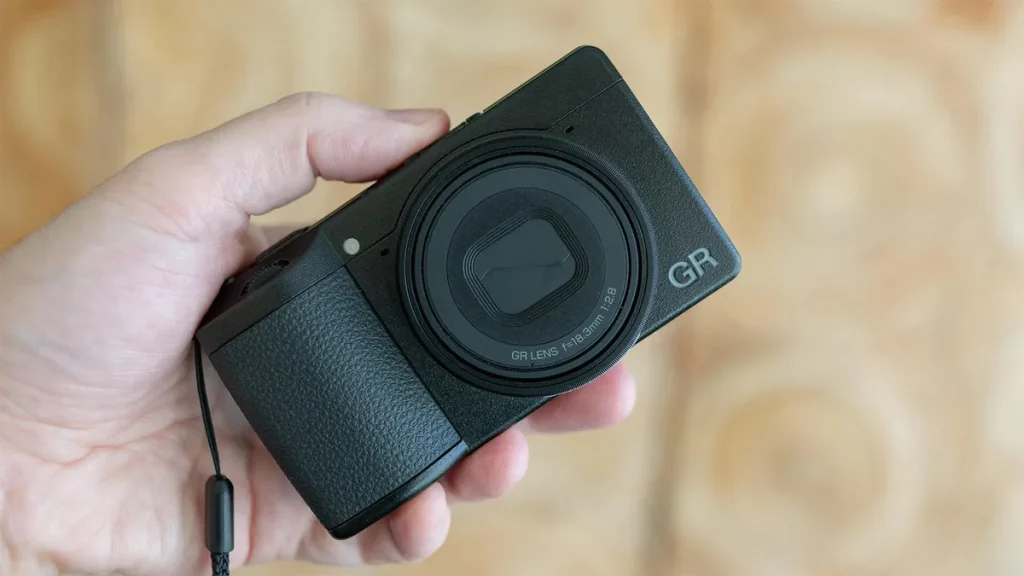
For existing GR III users, the upgrade decision hinges on whether the new features directly improve your shooting experience. The GR IV offers a meaningful performance uplift, but the overall feeling remains familiar. The new processor, 5‑axis stabilization, and improved autofocus are real benefits for street photographers who struggle with low‑light conditions or quick, unpredictable subjects. The redesigned lens with sharper corners and the 53GB internal storage are also welcome improvements. For GR II or older model users, the IV is a massive generational leap worth the new price.
Pros And Cons Of The Ricoh GR IV
Pros
- Extremely pocketable, lightweight (262g), yet rugged magnesium alloy build.
- 5‑axis in‑body stabilization (6 stops) – a first for the GR series.
- 0.6‑second start‑up time is the fastest ever, making it ideal for street work.
- Hybrid AF with face/eye detection is significantly faster and more reliable.
- 53GB internal storage is more than enough for days of shooting without extra cards.
- Revised 28mm f/2.8 lens offers improved edge‑to‑edge sharpness.
- GR Engine 7 delivers snappy interface and improved high‑ISO noise processing.
- 26MP BSI sensor provides excellent dynamic range and detail.
- Retains Snap Focus mode for fast zone focusing.
Cons
- 1,500pricetagisasteep600 increase over the GR III.
- No built‑in flash; external GF‑2 flash sold separately.
- Video limited to 1080p, no 4K option.
- Fixed screen, no tilt or articulating mechanism.
- No weather sealing, a notable omission for an everyday carry camera.
- Battery life (250 shots) is average and can drain quickly with intensive shooting.
- No electronic viewfinder; no accessory EVF option at all.
- Autofocus, while improved, still lags behind modern mirrorless competition.
Frequently Asked Questions (FAQs)
What is the price of the Ricoh GR IV?
The standard Ricoh GR IV launched in September 2025 at a manufacturer‘s suggested retail price of 1,499.95 USD. This is a 600 USD increase over the GR III’s 2019 launch price. The GR IV Monochrome variant is priced at 2,199.95 USD. Prices vary by region.
Is the Ricoh GR IV good for street photography?
Yes. The GR IV is purpose‑built for street photography. Its extremely fast 0.6‑second start‑up, silent operation, pocketable size, Snap Focus zone focusing, and improved low‑light performance make it an ideal tool for capturing candid moments.
Does the Ricoh GR IV have 4K video?
No. The GR IV is limited to 1080p (Full HD) video at up to 60 frames per second. New Cinema color modes (yellow/green tint) are included, but 4K is not available.
What is Snap Focus on the Ricoh GR IV?
Snap Focus is a Ricoh feature that allows the photographer to preset a specific focus distance (e.g., 1.5 meters or 2.5 meters). When using Snap mode, the camera instantly focuses to that distance, bypassing autofocus entirely. This enables the user to shoot from the hip and capture decisive moments without any focusing lag.