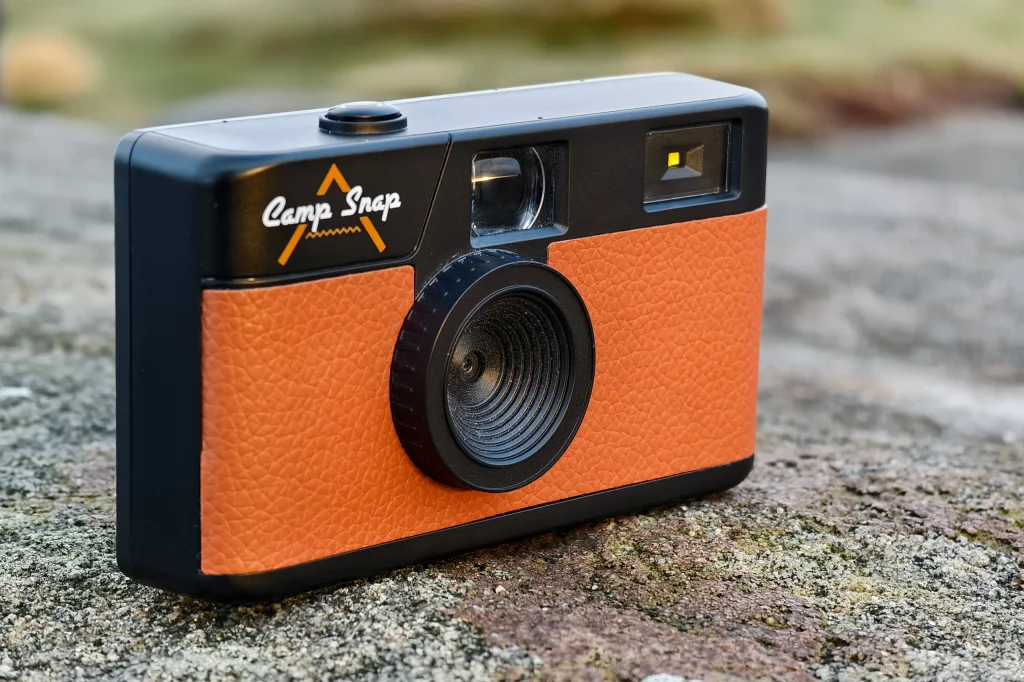
The Camp Snap camera is a digital camera that deliberately has no screen. It is designed to replicate the experience of using a disposable film camera: point, shoot, and only see your photos later when you transfer them to a computer. It was originally created for children attending summer camps that ban screens, but it has since found a much wider audience. This review covers the main models, image quality, battery life, and the growing community of enthusiasts who love this quirky, lo-fi camera.
Why A Screen-Free Digital Camera Exists
The Camp Snap camera was built on a very simple idea. Kids go to summer camp to be active, make friends, and enjoy nature. Screens, including the ones on smartphones and regular digital cameras, are a distraction. The Camp Snap camera has no screen, and it has only one button. You turn it on by holding down the shutter button, you take a photo by pressing it, and you turn it off by holding it again. A small counter on the back tells you how many shots you have taken, but you cannot review your photos until you plug the camera into a computer.
This simple design allows the camera to comply with camp rules that ban screens. But adults have also fallen in love with it. The lack of a screen forces you to stay in the moment. You cannot check your photos, so you do not take ten versions of the same shot. You just point, shoot, and move on. It is a mindful, almost meditative way of taking photos.
Key Features Of The Standard Camp Snap Camera
The standard Camp Snap camera is an 8 megapixel digital camera that comes in several bright colors. It has a fixed focus lens and an optical viewfinder. There is no zoom, no autofocus, and no settings to adjust except for the flash.
| Feature | Specification |
|---|---|
| Sensor | 8 megapixel CMOS |
| Lens | 35mm equivalent, f/3.2 fixed focus |
| Viewfinder | Optical tunnel-type |
| Flash | LED (On, Off, Auto) |
| Storage | 4GB microSD card (pre-installed, holds about 2,000 photos) |
| Battery | 600mAh non-removable rechargeable battery |
| Connectivity | USB-C for charging and file transfer |
| Interface | Single shutter button, flash switch, small photo counter |
| Dimensions | 2.5 x 4.5 x 1.0 inches |
| Weight | Approximately 143 grams (5 ounces) |
| Price | 65 to 70 US dollars |
The Camp Snap CS-Pro: What Has Changed

The Camp Snap CS-Pro is an upgraded version of the original. It costs more and comes with several improvements. The table below highlights the key differences.
| Aspect | Standard Camp Snap (8MP) | Camp Snap CS-Pro (16MP) |
|---|---|---|
| Sensor | 8 megapixel CMOS | 16 megapixel CMOS |
| Lens | 35mm equivalent f/3.2 | 22.5mm equivalent f/2.2 |
| Flash | LED | Xenon (two power settings) |
| Filter options | Requires firmware update | Four built-in filters via dial |
| Shutter lag | Noticeable delay | Sometimes delayed, but slightly improved |
| Battery life | Good | Vastly improved |
| Price | 65 to 70 USD | 99 USD |
The CS-Pro also includes a tripod mount, which is rare for this type of camera. It retains the screen-free design and one-button operation of the original, but the build quality feels more grown-up.
Image Quality: Poor By Normal Standards, Perfect For Its Purpose
The image quality of the Camp Snap camera is not good by modern standards. The colors can be washed out, the images are grainy, and the dynamic range is very limited. In low light, the photos are dark and noisy. The LED flash on the original model is weak and can make subjects look flat.
And yet, these flaws are the entire point.
The photos have a distinct lo-fi aesthetic. They look like they were taken on a disposable film camera or an early digital point-and-shoot from the early 2000s. This look is very popular on social media, especially among younger users who want an alternative to the clinically sharp images from smartphone cameras.
For a parent buying a camera for a child, the image quality is good enough. The photos are vibrant enough in sunlight, and the fixed focus lens keeps most subjects sharp from a few feet away. The kids will not care about pixel-level quality; they will care about the fun of taking pictures.
For adult photographers, the Camp Snap is a tool for creative exploration. The grain, the soft focus, and the unpredictable colors can be liberating. It forces you to let go of technical perfection and just have fun.
Battery Life And Storage
The standard Camp Snap camera has a 600mAh battery. It can take several hundred photos on a single charge, and the battery life is generally good for a full day or two of casual use. The CS-Pro has vastly improved battery life, and users report that it lasts much longer than the original.
The camera comes with a 4GB microSD card pre-installed. This holds about 2,000 photos. The card is accessible, but you need a small screwdriver to remove it. This is a deliberate design choice to prevent children from losing the card. Most people transfer photos via the USB-C cable instead of removing the card.
Transferring photos is simple. Plug the camera into a computer, and it appears as an external drive. You can then drag and drop the JPEG files to your hard drive. The photos are ready to view instantly, with no development costs and no waiting.
Community And Customization
One of the most surprising aspects of the Camp Snap ecosystem is its community. The camera is open to modification. Users have created custom firmware that changes the color profiles. You can load a new filter onto the camera by placing a file on the memory card and restarting the device.
This has led to a small industry of third-party filter makers. Companies and individuals offer different color profiles for download. You can make the camera mimic the look of Kodachrome, or you can create a black-and-white profile, or you can give it a harsh, high-contrast look. The ability to change the filter is a major selling point for creative users who want to experiment.
The CS-Pro has a built-in filter dial with four preset options, which makes it easier to switch between looks without loading new firmware.
Customer Feedback And Professional Reviews
Reviews for the Camp Snap camera are generally positive, but the praise is highly conditional. Professional reviewers consistently note that the image quality is poor, but they also say that is not the point.
Positive Feedback
- The camera is incredibly simple and easy to use, even for very young children.
- The screen-free design encourages mindfulness and reduces distraction.
- It is a durable, low-cost alternative to disposable film cameras.
- The lo-fi aesthetic is trendy and can be a creative outlet for photographers.
- The ability to load custom color profiles is a unique and fun feature.
- The CS-Pro offers genuine improvements in resolution, filter options, and battery life.
Critical Feedback
- Shutter lag is a real problem. The delay between pressing the button and taking the photo can cause you to miss spontaneous moments.
- The optical viewfinder is small and not perfectly aligned with the lens, so framing is approximate.
- The LED flash on the original model is weak and can be unpleasant to use.
- The lack of a screen means you cannot check your photos until later, which may frustrate children used to instant feedback.
- The CS-Pro has occasional shutter lag and an offset viewfinder, making framing tricky.
Pros And Cons Of The Camp Snap Camera
Pros
- Extremely simple to use, even for young children.
- No screen encourages you to stay in the moment and avoid distractions.
- Lo-fi image quality creates a nostalgic vintage aesthetic.
- Durable plastic build that can survive drops and bumps.
- USB-C charging and transfer is modern and convenient.
- Rechargeable battery lasts for hundreds of shots.
- Comes with a 4GB memory card that holds about 2,000 photos.
- Customizable color profiles via firmware updates.
- Affordable price, especially compared to shooting film.
Cons
- Image quality is poor by modern standards.
- Shutter lag can cause you to miss spontaneous moments.
- Fixed focus lens does not do close-ups.
- LED flash is weak and can be unpleasant to use indoors.
- No screen means you cannot review or delete bad photos in the camera.
- Optical viewfinder is small and not perfectly accurate.
- Transferring photos requires a computer; no wireless transfer.
- The CS-Pro model is more expensive than the original.
Frequently Asked Questions (FAQs)
Is the Camp Snap camera good for kids?
Yes. The original Camp Snap camera was designed for children attending summer camp. It is affordable, durable, and very easy to use. The lack of a screen means they will not be distracted by reviewing their photos, and they will remain present in their activities.
Can I see my photos on the camera?
No. The Camp Snap camera has no screen. You cannot review your photos until you transfer them to a computer or phone via the USB-C cable. This is a deliberate design choice.