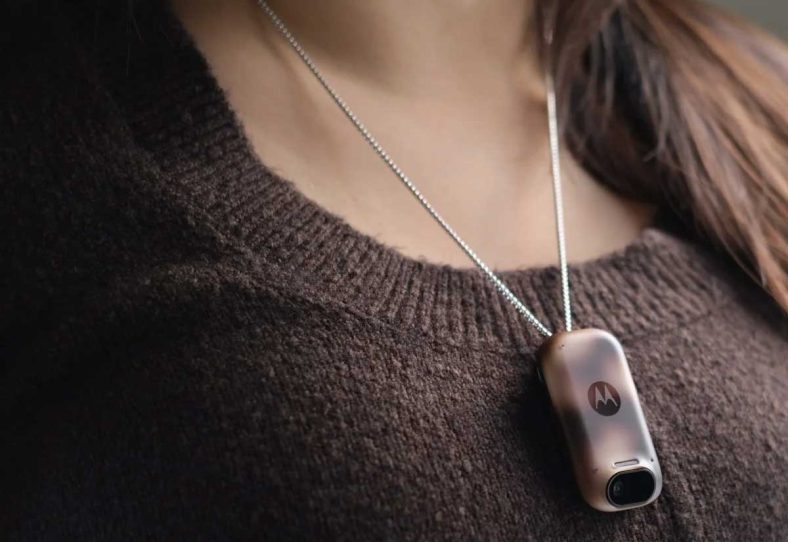
Motorola has entered the wearable AI space with Project Maxwell, a proof‑of‑concept pendant designed to be a hands‑free, context‑aware companion. Developed by Motorola‘s experimental 312 Labs, Maxwell hangs around your neck on a metal chain, equipped with a camera and microphones that allow it to see what you see and hear what you hear. Unlike previous failed attempts at AI wearables, such as the Humane AI Pin, Maxwell is not intended to replace your smartphone. Instead, it works alongside your other devices, feeding contextual data into Motorola‘s broader Qira AI ecosystem. The device was first shown at CES 2026 and later demonstrated at MWC in Barcelona. It remains a concept for now, with no official pricing or release date, but it signals Motorola‘s ambitious vision for the future of ambient AI.
Design And Form Factor: Wearable Technology As Functional Jewelry
Project Maxwell is designed to be worn comfortably all day, blending technology with fashion.
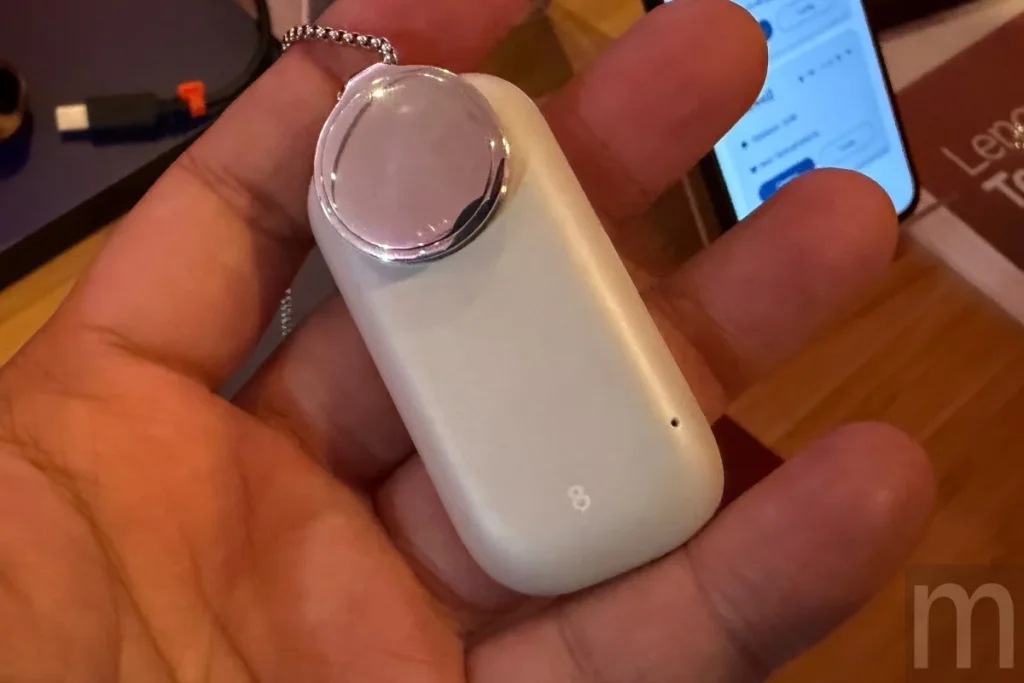
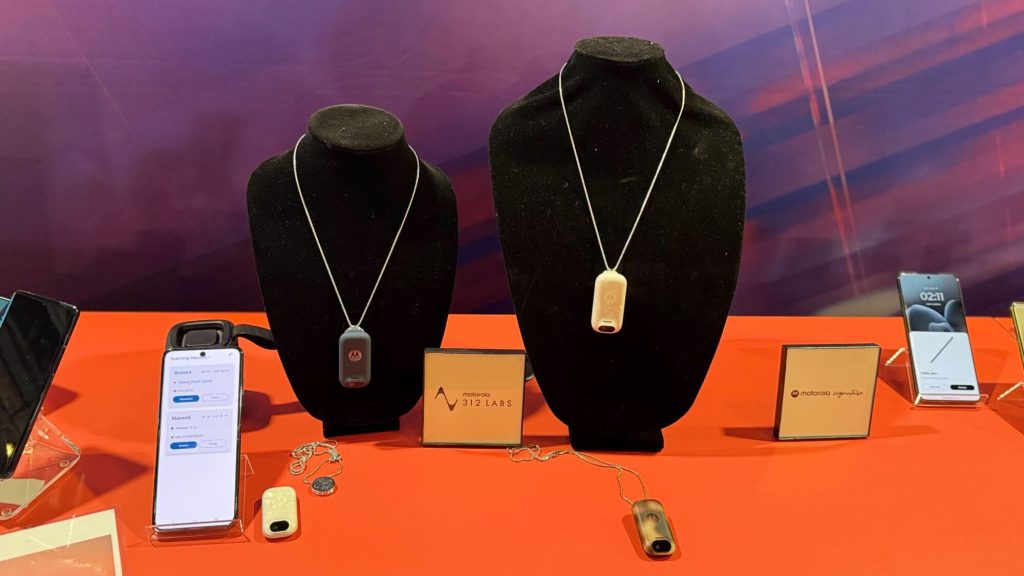
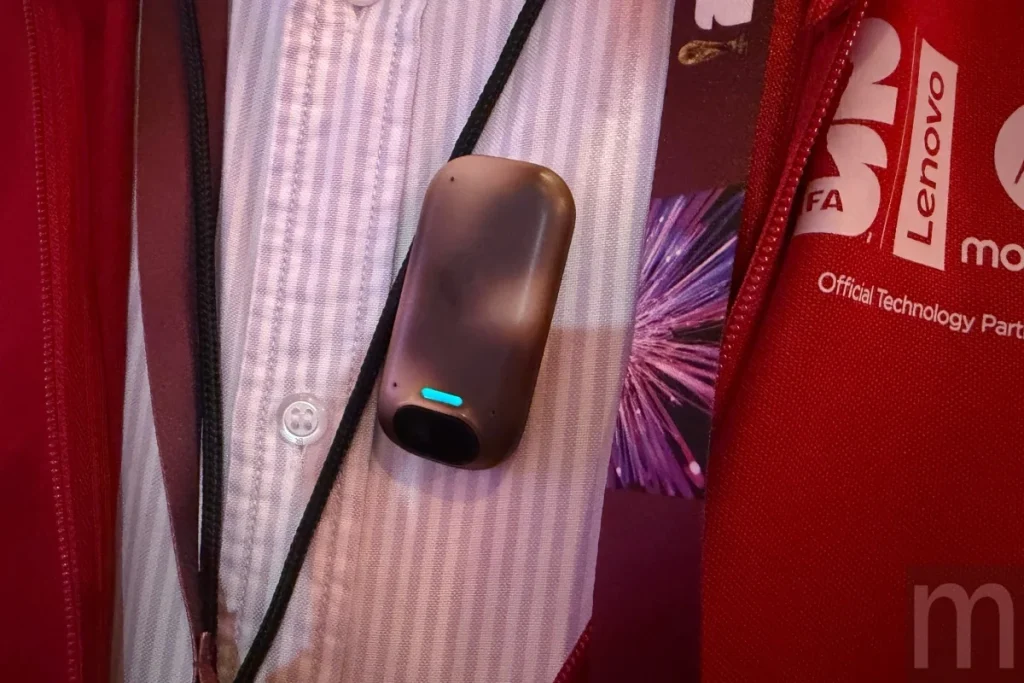
The device is a small, rectangular, pebble‑shaped pendant with softly rounded edges and no screen. It hangs from a metal chain, resembling functional jewelry rather than an obvious piece of technology. At one end sits a wide‑angle camera lens in a dark housing alongside a slim LED indicator. An integrated magnet allows flexible placement, so it can be worn as a pendant around the neck or pinned directly onto clothing. The pendant is designed in several distinctive finishes, including tortoiseshell amber with brown gradients, matte navy with a woven texture, marbled white, and deep chocolate brown. The dappled white finish is noted as a personal favorite by early reviewers.
The pendant feels lighter and less bulky than earlier AI pin attempts, reducing fatigue and making the device feel more like an accessory than a gadget. It sits on your chest in a passive position, giving the camera a first‑person view of the world without requiring you to change your posture to use it.
How Project Maxwell Works: Multimodal Perception And Contextual AI
Once activated, Project Maxwell continuously captures visual and audio information from the wearer‘s surroundings. The data is processed using Motorola‘s system called Multimodal Perception Fusion, which combines inputs from the camera, microphones and built‑in sensors. This allows the device to generate contextual suggestions in real time.
A second technical layer, Natural Language Interaction and Intention Capture, uses advanced AI models capable not only of answering questions but also of performing actions on behalf of the user. The device relies on a combination of built‑in microphones, a camera and various sensors to understand context.
Project Maxwell is designed to be part of a connected ecosystem, using Bluetooth for communication with other devices such as a paired Motorola smartphone or wireless headphones. You can connect wireless earbuds via the settings menu of the phone paired with the Project Maxwell device, allowing for private audio feedback.
The device currently uses an older wearable chip, but the increased power efficiency of the Snapdragon Wear Elite platform and the ability to process locally on device opens up new opportunities for Motorola to experiment further.
Hands‑Free Assistance: Reading Menus, Translating Conversations And More
Project Maxwell‘s core use cases focus on productivity and everyday assistance without requiring you to pull out your phone.
Real‑time menu translation and recommendations
In a demonstration, Mohammed Abdul‑Gaffoor, executive director of engineering at Motorola‘s 312 Labs, showed how the device can read a menu in a foreign language and make recommendations about dishes he might like based on its knowledge of his preferences. You can point at a menu and ask if there is anything gluten‑free, and the AI will look at the text, process the audio and give you an answer through its small speaker slit or connected earbuds.
Live conversation translation
Like other wearable AI devices, Project Maxwell can translate a real‑time conversation between two people speaking different languages, breaking down language barriers without fumbling for a translation app on your phone.
Turn‑by‑turn directions
The pendant can offer navigation guidance, allowing you to keep your eyes on the road or the street ahead without glancing at a screen.
Automatic meeting note‑taking
One of Maxwell‘s core productivity features is the ability to take meeting notes automatically while you focus on conversations. Before attending a keynote speech, a user can activate Maxwell and let it observe the environment. After the session, the device could automatically generate a draft social media post summarising the talk—ready to edit and publish—without the user opening a single app.
Hands‑free photo capture
Maxwell can also capture photos without requiring you to pull out your phone, making it useful for documenting moments or quickly scanning information.
A Learning Sensor: Feeding Context Into The Qira AI Ecosystem
Project Maxwell is more than just a hands‑free assistant; it serves as a learning sensor that inputs data about your life, preferences and surroundings to provide other devices with context. The goal is to integrate AI into everyday activities so it works quietly in the background rather than requiring constant manual interaction.
When activated, Project Maxwell elaborates in modo continuo i dati che lo circondano, combinando visione, audio e informazioni contestuali. This awareness enables personalised and contextually relevant suggestions rather than generic responses.
For example, you could attend a conference, ask Project Maxwell to listen to a keynote speech and later request it to draft a LinkedIn post with a summary of the event—all without taking out your phone or breaking concentration. The system also relies on natural language interaction and intention capture, powered by large action models that not only answer questions but also execute actions initiated by the user. In this way, AI can automate tasks and optimise daily workflows based on context.
Deep Integration With The Qira AI Ecosystem
Project Maxwell occupies a central place within Qira, the new AI platform announced by Lenovo and Motorola that unifies their existing tools—Moto AI, Lenovo AI Now, Creator Zone and Learning Zone—under a single name, interface and wake word. The move follows key learnings from previous products, which showed that users often feel overwhelmed switching between apps and devices, rewriting prompts and training new tools.
With Qira, Lenovo and Motorola aim to offer a continuous AI experience across phones, PCs and future devices. Context follows the user, allowing the system to remember, anticipate and respond consistently regardless of which device you are using. Project Maxwell carries that vision beyond screens, acting as a persistent and ambient access point to the Qira ecosystem. Insights from the Maxwell prototype are being integrated into the broader Qira AI ecosystem, which explores hands‑free, context‑aware AI experiences.
Project Maxwell Vs Humane AI Pin And Other AI Wearables
Project Maxwell belongs to a new cohort of AI wearables that take advantage of advances in large language models and agentic AI to provide a new experience. However, Motorola has learned from the failures of previous attempts.
| Aspect | Project Maxwell | Humane AI Pin |
|---|---|---|
| Primary Purpose | Context‑aware companion, works alongside your phone | Attempted phone replacement |
| Screen | No screen | No screen (laser projected display) |
| Interaction | Voice, camera, microphones | Voice, camera, gesture, laser projection |
| Battery | Works with your phone to prevent overheating and ensure all‑day battery | Known for battery and heat issues |
| Price | Not announced | 699 USD plus 24 USD monthly subscription |
| Availability | Concept / proof‑of‑concept | Briefly released, now discontinued |
Unlike the Humane AI Pin that tried to replace your phone and failed due to heat and battery issues, Project Maxwell works with your phone. This prevents the necklace from overheating and ensures the battery lasts throughout the day. The device is also noticeably lighter and less bulky than earlier AI pin attempts, making it more practical for daily wear.
Motorola‘s Abdul‑Gaffoor is the first to admit that the concept of a pin is not new, but this is perhaps the first time a major existing player in the mobile market has thrown any weight behind the idea.
Privacy, Data Collection And The Challenges Ahead
As with many wearable AI devices that continuously capture audio and video from their surroundings, questions about privacy and data collection remain important. Issues such as consent and data handling will likely shape how a product like this could be introduced to the public. The device continuously captures visual and audio information from the wearer‘s surroundings, processing it using Motorola‘s Multimodal Perception Fusion system.
Motorola has not announced pricing, release plans or final hardware specifications. Even if Maxwell itself never reaches the market, the project serves another purpose: insights from the prototype are being integrated into its broader Qira AI ecosystem. The larger question for the industry may not be whether an AI pendant is technically useful, but whether people will actually feel comfortable wearing one in daily life.
Availability And Future Outlook
Project Maxwell remains a concept device. Motorola has not announced pricing, release plans or final hardware specifications. However, the device will initially launch in select markets ahead of wider availability closer to the FIFA World Cup. It was developed to see how AI can be used in everyday life, with the data collected serving as the basis for the development of future Motorola products.
Even if Maxwell itself never reaches the market, the project serves another purpose: insights from the prototype are being integrated into its broader Qira AI ecosystem, which explores hands‑free, context‑aware AI experiences.
Pros And Cons Of Project Maxwell
Pros
- Hands‑free, heads‑up interaction allows you to stay present in the moment.
- Multimodal perception fusion combines audio, visual and sensor data for deep contextual understanding.
- Works alongside your smartphone rather than trying to replace it, avoiding the pitfalls of previous AI pins.
- Integrated magnet allows flexible wearing options: pendant or pin.
- Lightweight, pebble‑shaped design with multiple attractive finishes.
- Part of Motorola and Lenovo‘s unified Qira AI ecosystem, ensuring seamless context across devices.
- Can automatically take meeting notes, capture photos and draft social media posts.
- Real‑time translation and menu reading capabilities.
Cons
- Remains a proof‑of‑concept; no official pricing or release date announced.
- Privacy concerns due to continuous audio and video capture.
- Requires a paired smartphone for full functionality.
- Unknown battery life (though designed to work with your phone to preserve charge).
- Unclear whether the device will ever reach the consumer market.
- No screen may limit some interactions.
- Dependent on the success and adoption of the wider Qira AI platform.
Frequently Asked Questions (FAQs)
What is Project Maxwell?
Project Maxwell is a proof‑of‑concept wearable AI pendant developed by Motorola‘s experimental 312 Labs. It hangs around your neck, equipped with a camera and microphones, and functions as a perceptive, hands‑free AI companion.
When will Project Maxwell be released?
Motorola has not announced an official release date. The device is currently a concept. It is expected to launch initially in select markets ahead of wider availability closer to the FIFA World Cup.