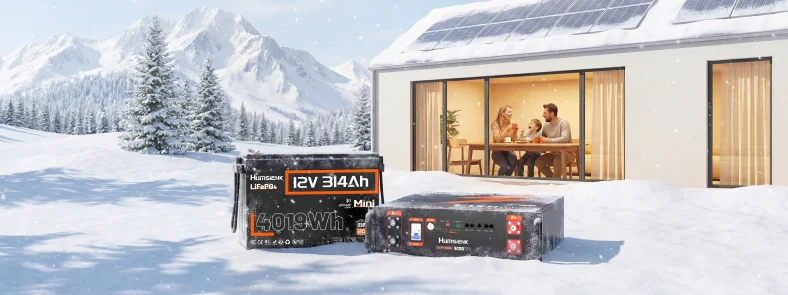
HumsiENK is a budget-focused lithium battery brand operated by Shenzhen Humsienk New Energy Technology Co., Ltd. The company specializes in LiFePO4 (Lithium Iron Phosphate) batteries for RVs, solar energy storage, golf carts, marine applications, and off-grid systems. Humsienk offers highly competitive pricing, often undercutting well-known budget brands, while including features like Bluetooth BMS monitoring and claimed high cycle life.
The brand has gained significant attention from the DIY solar and RV community, largely due to its aggressive pricing and real-world capacity test results. However, potential buyers have raised serious concerns about BMS safety issues, build quality inconsistencies, and mixed customer service experiences. This review covers product specifications, performance, pros and cons, security analysis, customer feedback, safety warnings, and comparisons with other budget battery brands.
Product Lineup, Specifications And Pricing
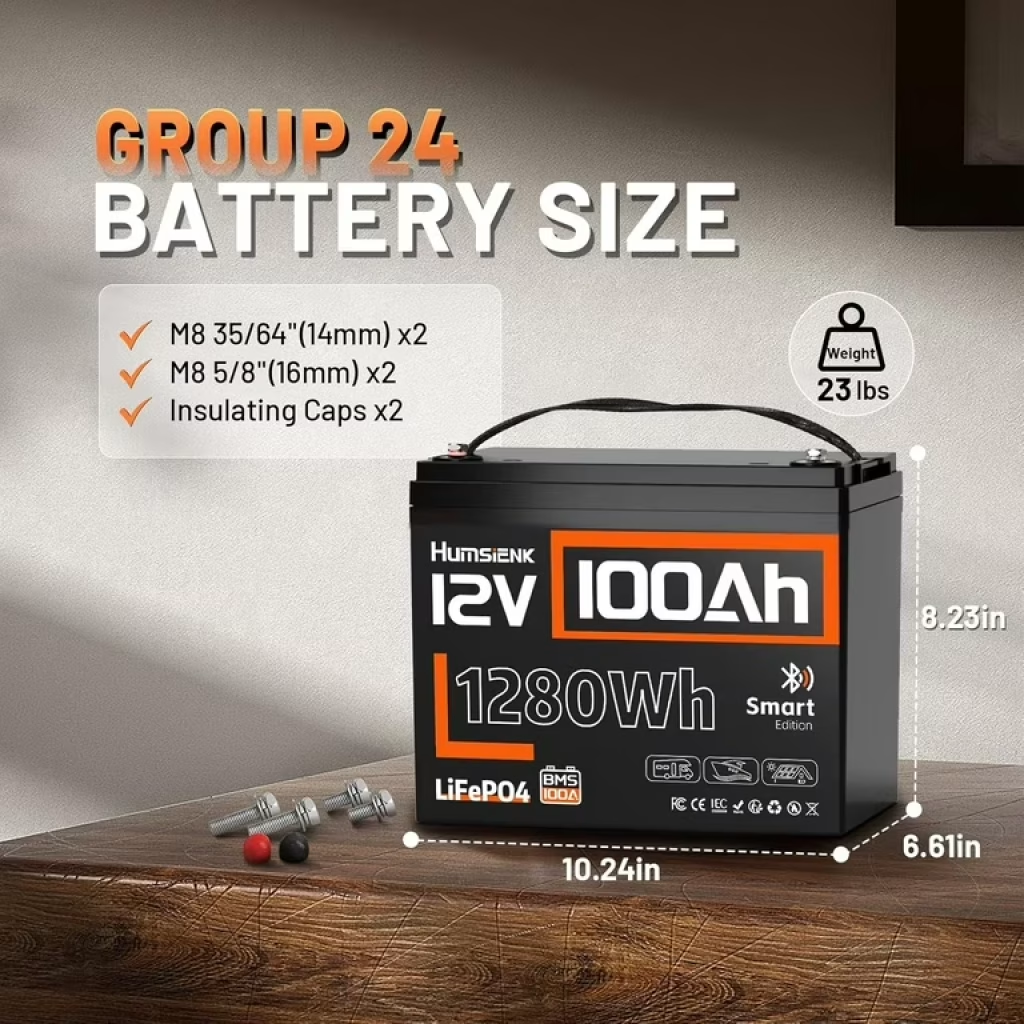
Humsienk offers a range of LiFePO4 batteries in various voltages and capacities to suit different applications. Below is a summary of their core products based on official listings and third-party teardowns.
| Model | Nominal Voltage | Capacity (Ah) | Energy (Wh) | BMS Rating | Weight | Approx. Price (USD) | Key Features |
|---|---|---|---|---|---|---|---|
| 12V 100Ah Bluetooth | 12.8V | 100Ah (104Ah real) | 1,280Wh | 100A | 27.5 lbs (12.5 kg) | $145 | Bluetooth BMS, low-temp cutoff, cylindrical cells |
| 12V 150Ah Bluetooth | 12.8V | 150Ah | 1,920Wh | 100A | ~35 lbs | $229 | Same BMS, higher capacity |
| 12V 310Ah Mini Bluetooth | 12.8V | 310Ah | 3,968Wh | 200A | ~55 lbs | $530 | Mini form factor, 200A BMS |
| 12V 640Ah (Teardown Model) | 12.8V | 640Ah | 8,192Wh | Not specified | ~100+ lbs | $749 | Large capacity, known issues |
| 48V 100Ah Server Rack | 51.2V | 100Ah | 5,120Wh | 100A | ~70 lbs | $512 (sale) | 3U rack-mount, Bluetooth, for solar storage |
| 48V 314Ah Wall-Mount | 51.2V | 314Ah | ~16,000Wh | 200A | ~200+ lbs | ~$1,200 | High-capacity wall-mount for home backup |
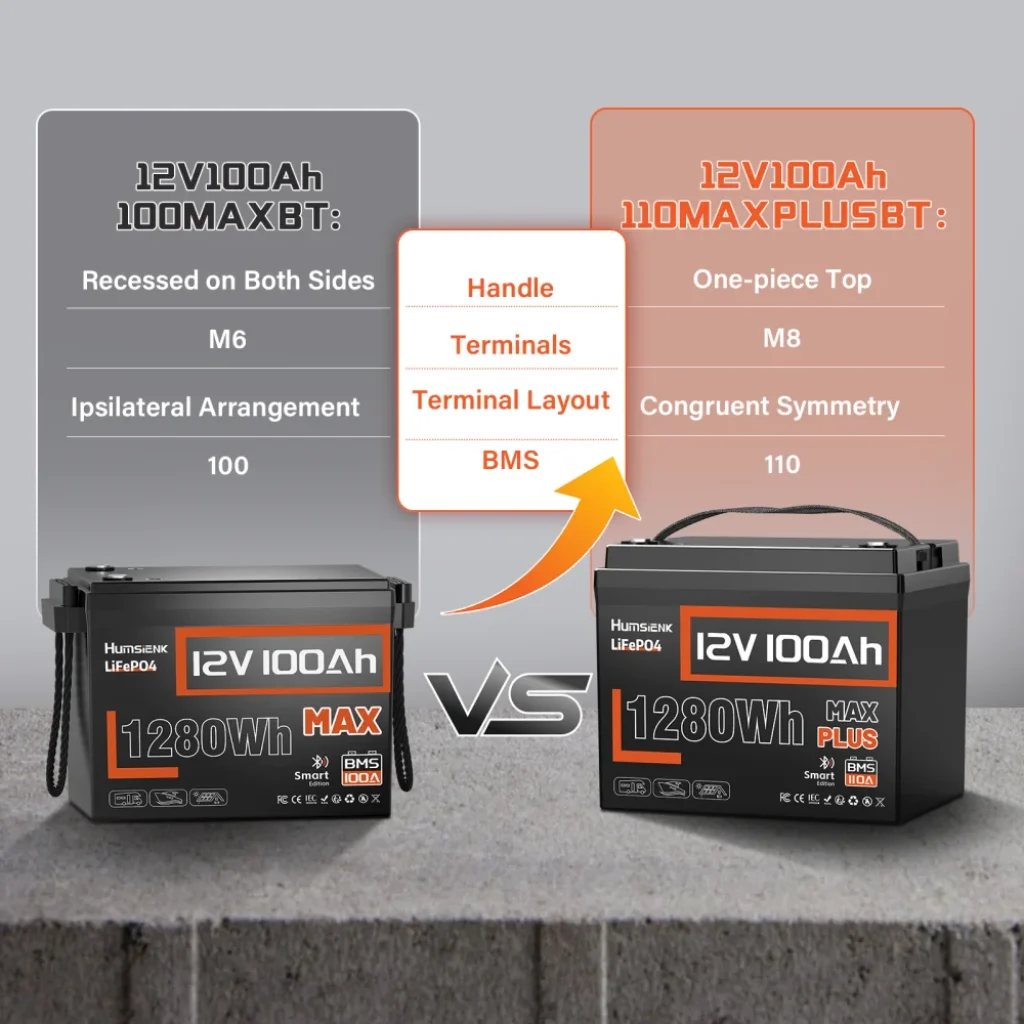
The 12V 100Ah model is the most popular entry point for RVs and solar applications. Cylindrical cell designs provide good thermal management and cell matching, with a claimed cycle life of 4,000 to 15,000 cycles depending on depth of discharge (DoD). The Bluetooth BMS allows real‑time monitoring of voltage, temperature, and cell balance via the manufacturer‘s proprietary app, available on both the Apple App Store and Google Play Store.
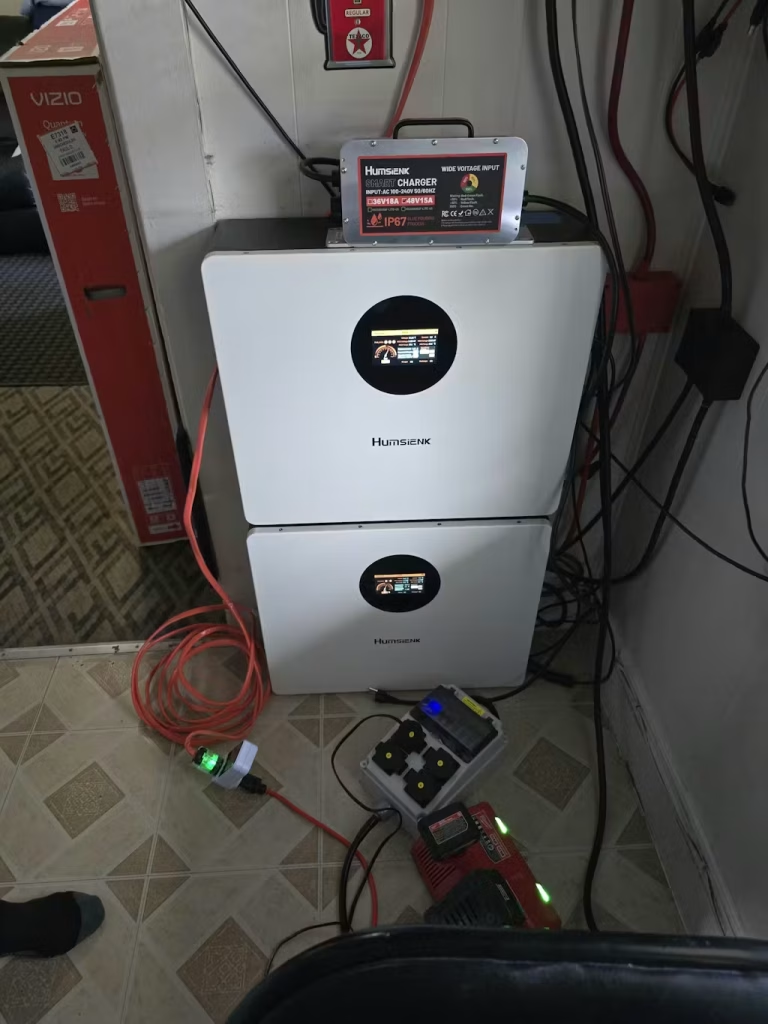
Real-World Performance And Capacity Testing
The Humsienk 12V 100Ah LiFePO4 battery, priced at just 145 USD, consistently delivers real capacity that meets or exceeds its advertised rating. An owner testing the 314Ah 200A BMS Smart Mini battery using a 2000W pure sine wave inverter running a 1kW fan heater recorded a total of 318Ah at 100% depth of discharge, exceeding the rated capacity of 314Ah as measured by a precision battery monitor.
Another user verified that the real capacity of a 12V 100Ah battery perfectly matches the declared specs using a high-precision coulomb meter, confirming that Humsienk does not exaggerate its capacity ratings. In one long-duration overlanding test, a single Humsienk 12V 100Ah battery paired with a 200W foldable solar panel array successfully ran a portable fridge, LED lighting, and USB charging stations for seven days without generator support. Daily usage averaged 45–55 Ah per day, and voltage never dropped below 12.8V even after four nights without sun exposure.
High-current load handling is also impressive. The battery maintained voltage at 12.6V under a combined load of a 1,500W microwave oven and a 1,200W space heater (nearly 3 kW total), with only a momentary drop from 13.2V resting to 12.6V under load, and without triggering inverter shutdown. The battery supports continuous AC loading up to 3,840 watts with proper wiring and ventilation.
The weight advantage is dramatic. A traditional dual Group 27 flooded lead-acid (FLA) setup weighs 140 lbs and provides only about 100Ah of usable capacity (limited by 50% depth of discharge). The Humsienk 12V 100Ah battery offers 100Ah usable capacity at just 27.5 lbs — a net weight saving of 110 lbs — while also being smaller, faster to charge (reaching 90% SOC in under 3 hours versus 8+ hours for lead-acid), and maintenance‑free. The battery offers a lifespan estimate of up to 3,500 cycles, compared to only 300–500 cycles for lead-acid.
Security And Legitimacy Check
Humsienk exhibits characteristics common to legitimate e-commerce businesses but also raises some caution flags. The website utilizes Shopify as its e-commerce engine, which typically ensures a baseline level of transaction security. An independent security analysis gives Humsienk.com a trust score of 70 out of 100, concluding that the website is safe and usable. The analysis notes that the domain, established in May 2024, has aged and stabilized, and the site is a legitimate operation selling physical goods via recognized platforms.
However, another European security analysis gave a very negative score of 30 out of 100, advising caution before making purchases on what it describes as a potentially risky dropshipping site. A third independent scanner is undecided on the eu.humsienk.com domain, listing positive highlights like valid SSL certificates and safe DNSFilter ratings, but noting that the site uses a privacy service to hide the owner‘s identity and has mixed reviews.
Trustpilot Ratings And Verified Customer Reviews
Humsienk has a split reputation across different regional Trustpilot profiles. The global profile maintains a solid 4.6 out of 5 “Excellent” rating based on hundreds of reviews. Users consistently praise the product’s quality, prompt shipping, responsive customer service, and excellent value for money.
A typical positive review from Australia states: “Absolutely amazing customer service, my questions were answered within 5 minutes. And the 314Ah Mini Smart battery I bought is really great. I tested loading it with a 2000w inverter at maximum power and 170A discharge current, and the battery lasted 2 hours.” Another user commented: “They showed up quick, they were a good price, showed up 50% charged, couldn’t have asked for anything better.”
However, the EU-specific profile has a much lower 3.2 out of 5 “Average” rating. One German customer reported: “We bought a 12V 300Ah battery via an online marketplace from seller humsienk-eu in April 2025. After 5 months it became defective and we contacted the seller to make a complaint.” The disparity reflects differing regional experiences, particularly with warranty claims and customer support in Europe.
Critical Safety And Build Quality Issues
The DIY solar community has documented several serious concerns about Humsienk batteries. These issues may not affect every unit, but they are significant enough to warrant caution for high-risk or always-on installations.
BMS Safety Issue – Self-Discharge at 0% SOC
One user reported that two Humsienk 314Ah 12V smart LiFePO₄ batteries began self-discharging with no external load or wiring connected. Discharge continued even when “discharge” was disabled in the app, and continued at 0% SOC, indicating the BMS is not enforcing a hard cutoff. Power draw was observed in the 70–130 W range, completely idle. The voltage steadily declined over days, and the pack continued to draw power down to levels that could over-discharge the cells and create a safety risk when attempting recharge. The user noted that defective lithium batteries cannot be legally shipped back by individuals under hazardous materials shipping regulations.
Teardown Issues – Damaged Components And Poor Assembly
A teardown of the 12V 640Ah model revealed several problems. The low-temperature sensor was pinched due to poor routing and was non-functional. Shipping damage bent the positive busbar and one cell buckled. Cells were taped instead of strapped properly, and the BMS did not disconnect when amperage exceeded its rating. The failure of low-temperature charging is a problem because charging a LiFePO₄ battery below freezing without cutoff can cause irreversible cell damage. The dented cell is also a direct safety risk.
Cell Imbalance In Series Configurations
Another user reported a consistent cell imbalance in Humsienk batteries. Three cells charge up to 3.55–3.65 volts, while one cell in each battery stays around 3.45–3.47 volts. The BMS shuts off charging when any cell hits 3.65 volts, leaving the lower cell(s) much further behind. This issue is particularly problematic when batteries are connected in series for 24V or 48V systems.
Humsienk Vs LiTime Vs Renogy: Which Budget LiFePO4 Battery Wins
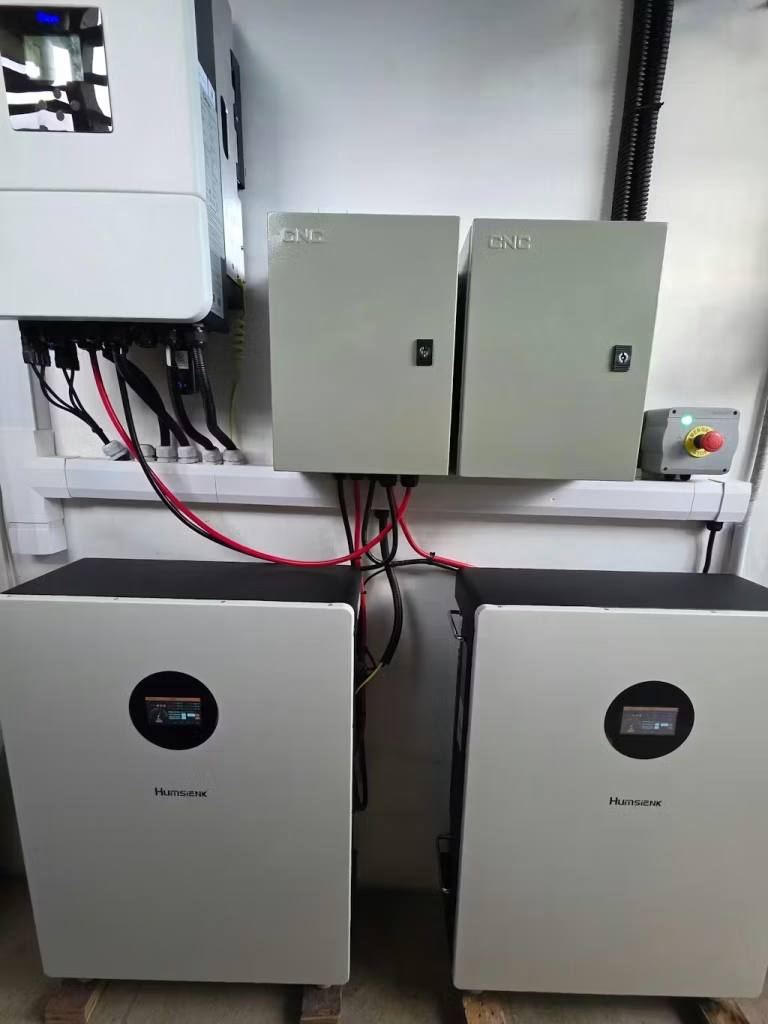
Humsienk competes directly in the budget lithium battery segment against established brands like LiTime and Renogy. The table below compares the 12V 100Ah models from each brand.
| Aspect | Humsienk 12V 100Ah | LiTime 12V 100Ah (Plus) | Renogy 12V 100Ah |
|---|---|---|---|
| Bluetooth BMS | Yes (standard, proprietary) | Yes (standard, compatible with third-party apps) | Yes (optional, via Renogy app) |
| Cell Type | Cylindrical | Prismatic | Prismatic |
| Real Capacity | 104Ah (tested) | ~100–102Ah (typical) | ~100Ah |
| Low-Temp Cutoff | Yes (but some units faulty) | Yes (Self-Heating series) | Yes (via app setting) |
| Continuous BMS Rating | 100A | 100A (200A Peak) | 100A |
| Weight | 27.5 lbs | ~24 lbs | ~26 lbs |
| Price (approx) | $145 | $170 | $200 |
| Warranty Experience | Mixed (Global good, EU poor) | Generally good | Generally good |
| BMS Transparency | Proprietary app only | JK / JBD-compatible | Proprietary app |
| Best For | Lowest upfront cost | Consistent quality monitoring | Established brand trust |
Why choose Humsienk: Choose Humsienk if you want the absolute lowest upfront cost and are comfortable with potential BMS quirks and a less transparent warranty process.
Pros And Cons Of Humsienk Lithium Batteries
Pros
- Very competitive pricing per watt-hour, often 30–50 percent cheaper than major competitors.
- Verified real capacity that meets or exceeds advertised ratings (104Ah measured in a 100Ah model).
- Lithium Iron Phosphate (LiFePO₄) chemistry provides excellent thermal stability and safety.
- Built-in Bluetooth BMS allows real-time cell voltage, temperature, and capacity monitoring via smartphone app.
- Good low-temperature charge protection – the BMS is rated to prevent charging below freezing (though some units have faulty sensors).
- Dramatically lighter than lead-acid (27.5 lbs vs 140 lbs for equivalent usable capacity).
- Strong, consistent voltage output under typical loads, with minimal voltage sag even at high power draws.
- Fast charging – reaching 90% SOC in under 3 hours compared to 8+ hours for lead-acid.
- Zero maintenance – no need for distilled water or terminal cleaning.
- Properly laid out internal design with tidy wiring in well-assembled units.
- Effective top-of-charge cell balancing in properly functioning units.
Cons
- Multiple reports of BMS safety issues, including self-discharge at 0% SOC without a hard cutoff.
- Known cell imbalance problems when cells are connected in series for 24V or 48V systems.
- Proprietary BMS is accessible only via the manufacturer‘s Android app, not compatible with third-party apps.
- The 100A BMS generates concerning heat under high continuous loads – some teardowns indicate it may be undersized for long-duration high-current applications.
- Reports of improperly assembled units with pinched low-temperature sensors, taped cells instead of strapped, and missing insulation.
- Shipping damage has been reported, including bent busbars and buckled cells.
- Mixed warranty support experiences, particularly in Europe (EU domain has a 3.2/5 Trustpilot rating, global has 4.6/5).
- Returning defective batteries can be difficult because lithium batteries cannot be legally shipped by individuals under hazardous materials regulations.
- Battery can enter a hard “sleep” BMS shutdown when over-discharged, requiring external “wake-up” with a suitable charger.
- Security trust scores are mixed, ranging from 70 out of 100 to scam cautionary warnings.
Frequently Asked Questions (FAQs)
Is Humsienk a trustworthy brand?
The brand is legitimate, but with mixed feedback. Professional teardowns show decent build quality for the price in many units. However, serious BMS safety issues and cell imbalance problems have been documented in some models. The EU store has a lower Trustpilot rating and complaints about warranty handling. Always use a credit card or PayPal for buyer protection.
Are Humsienk batteries fully compatible with my RV solar system?
Yes. Humsienk LiFePO₄ batteries are compatible with most RV solar systems and inverters. The built-in BMS protects against overcharging, deep discharge, and short circuits. However, you must use a lithium-specific charger or a programmable solar charge controller with a LiFePO₄ profile for optimal performance and safety.
Does the Humsienk battery have reliable low-temperature protection?
The BMS is rated to prevent charging when the internal temperature drops below 32 degrees Fahrenheit (0 degrees Celsius) to prevent cell damage. However, a teardown of the 12V 640Ah model found that a pinched low-temperature sensor was non-functional. The failure of low-temperature charging is a significant problem because charging a LiFePO₄ battery below freezing can cause irreversible cell damage.
Why will my Humsienk battery not wake up after full discharge?
If the battery is drained below its low-voltage cutoff, the BMS will enter a protective sleep mode. To wake it up, temporarily apply a charging voltage of around 14.2V to 14.6V to the battery terminals. A standard lithium battery charger should do this automatically soon after being connected.
What is the actual warranty on Humsienk batteries?
Can Humsienk batteries be used for high continuous discharge applications?