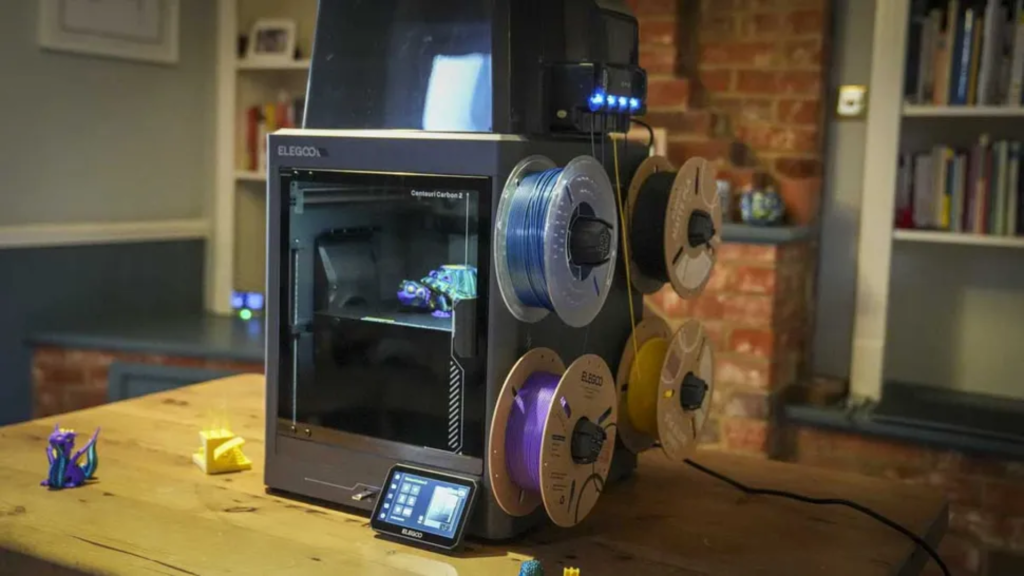
Elegoo has announced the Centauri Carbon 2, the successor to its popular Centauri Carbon printer. The new model adds an optional Color Filament System (CFS), bringing multi‑color and multi‑material printing to an affordable, fully enclosed CoreXY platform. The Centauri Carbon 2 features a 350°C all‑metal hotend, an active heated chamber, a 256x256x256 mm build volume, and print speeds up to 400 mm/s. The CFS is Elegoo‘s answer to Bambu Lab‘s AMS, allowing up to four filaments to be loaded simultaneously for automatic switching during prints.
Centauri Carbon 2: Core Specifications And Upgrades
The Centauri Carbon 2 is a fully enclosed CoreXY 3D printer designed for printing engineering‑grade materials like ABS, ASA, nylon and polycarbonate. It builds on the success of the original Centauri Carbon with several key improvements.
Core specifications:
- Build volume: 256 x 256 x 256 mm (cubic, similar to Bambu Lab X1C)
- Print speed: up to 400 mm/s (standard), 600 mm/s max travel speed
- Acceleration: up to 20,000 mm/s²
- Hotend temperature: up to 350°C (all‑metal)
- Heated bed temperature: up to 120°C
- Active heated chamber: up to 65°C
- Extruder: direct drive with hardened steel nozzle
- Build plate: flexible magnetic PEI spring steel
- Motion system: CoreXY with linear rails on X, Y and Z axes
- Filament runout sensor: yes
- Power loss recovery: yes
- Filament drying: active drying in the CFS (Color Filament System)
Key upgrades over the original Centauri Carbon:
- Added the CFS (Color Filament System) for multi‑color and multi‑material printing.
- Increased build volume (the original had a smaller cubic build area).
- Improved maximum hotend temperature (now 350°C vs 300°C).
- Higher print speeds (400 mm/s vs 250 mm/s).
- Active heated chamber for better engineering material printing.
- Linear rails on all axes for improved precision and longevity.
The printer maintains Elegoo‘s commitment to open‑source software. It runs Klipper firmware and is compatible with OrcaSlicer, PrusaSlicer, Cura and other popular slicing software. This is a significant advantage over Bambu Lab‘s closed‑source ecosystem.
Color Filament System (CFS): Elegoo‘s Answer To Bambu AMS
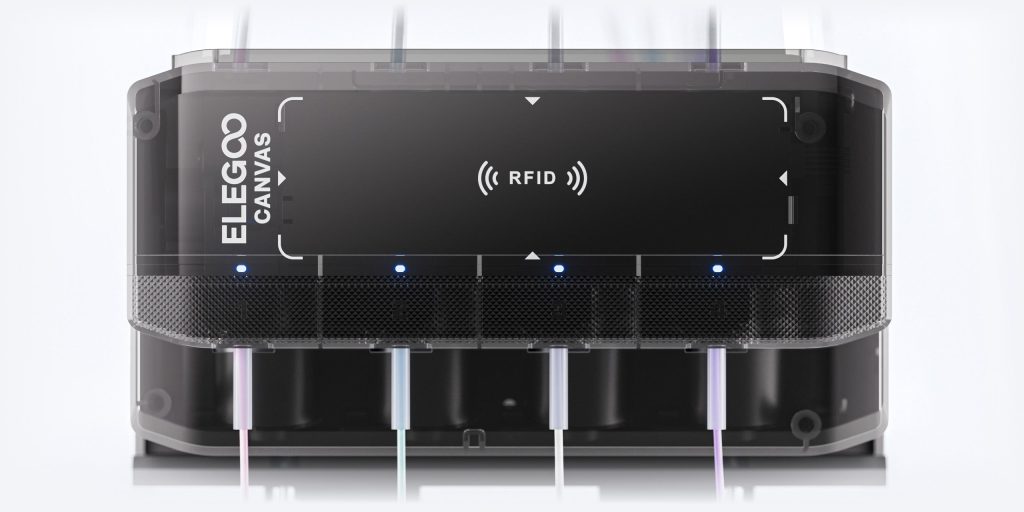
The CFS is a four‑spool filament holder and switching system that attaches to the top of the Centauri Carbon 2. It allows you to load up to four different filaments (different colours or different materials) and the printer will automatically switch between them during a print.
CFS features:
- Four spool holders, each with independent filament runout detection.
- Automatic filament switching during prints for multi‑colour and multi‑material objects.
- Active filament drying to keep hygroscopic materials (nylon, TPU, PETG) dry during long prints.
- Filament type detection (automatically identifies PLA, PETG, ABS, etc).
- Reverse Bowden tube system for smooth filament feeding.
With the CFS, you can create prints with up to four colours or combine different materials in a single object (for example, using a support interface material that dissolves or breaks away cleanly). The CFS is included in the Combo model and is also available separately for owners of the original Centauri Carbon.
Print Quality, Speed And Material Capabilities
The Centauri Carbon 2 is designed to handle a wide range of filaments, from simple PLA to advanced engineering materials.
Filament compatibility:
- Standard: PLA, PETG, TPU, ABS, ASA
- Engineering: Nylon, Polycarbonate (PC), Carbon‑Fibre reinforced filaments (CF, GF)
- Flexible: TPU (with direct drive extruder)
- Support materials: PVA, HIPS, BVOH (with CFS)
Print speed and quality:
- The printer can achieve 400 mm/s print speeds while maintaining good quality, thanks to the CoreXY motion system and high acceleration.
- The 20,000 mm/s² acceleration allows for rapid direction changes without ghosting or ringing.
- The heated chamber (up to 65°C) is essential for printing ABS, ASA and nylon without warping or layer separation.
Active heated chamber:
The actively heated chamber is a significant upgrade over the original Centauri Carbon. It maintains a consistent internal temperature, preventing drafts and temperature fluctuations that can cause warping. This feature is typically found on much more expensive printers (like the Bambu Lab X1C and Qidi Tech Plus4).
Centauri Carbon 2 Vs Bambu Lab X1C Vs Qidi Tech Plus4
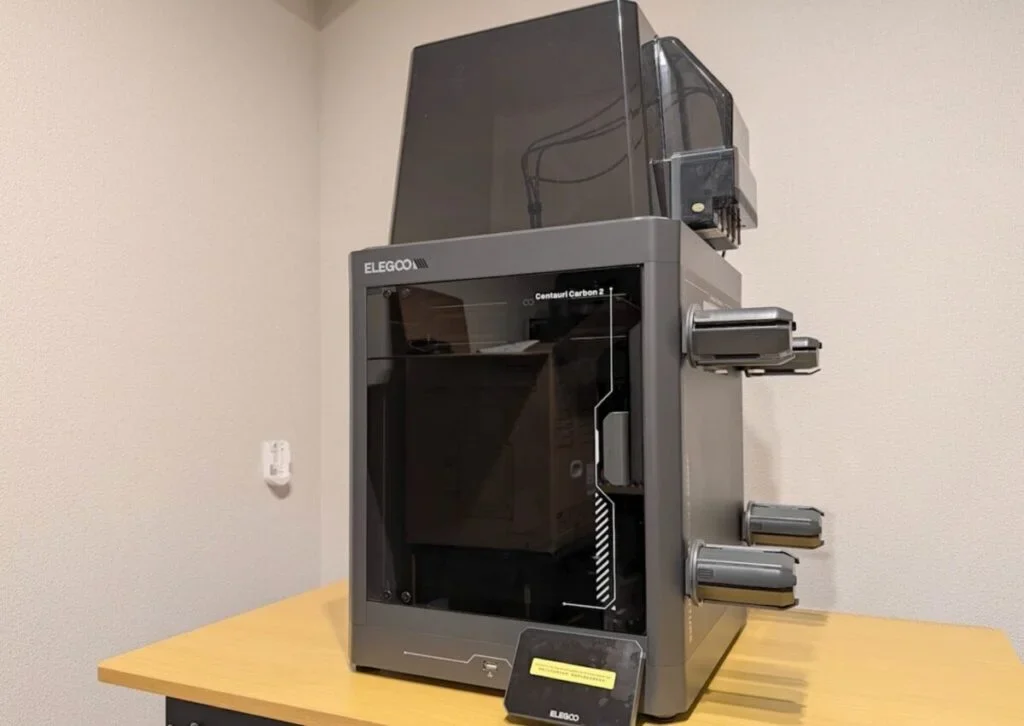
The Centauri Carbon 2 Combo is positioned as a direct competitor to Bambu Lab‘s X1C Carbon Combo and Qidi Tech‘s Plus4. The table below highlights the key differences.
| Aspect | Elegoo Centauri Carbon 2 Combo | Bambu Lab X1C Carbon Combo | Qidi Tech Plus4 |
|---|---|---|---|
| Price (Combo) | $799 | $1,450 | $1,000 |
| Build Volume | 256x256x256 mm | 256x256x256 mm | 300x300x300 mm |
| Max Nozzle Temp | 350°C | 300°C | 350°C |
| Max Bed Temp | 120°C | 120°C | 120°C |
| Chamber Heating | Active (up to 65°C) | Passive | Active (up to 65°C) |
| Max Speed | 400 mm/s | 500 mm/s | 400 mm/s |
| Multi‑Material System | CFS (4 spools) | AMS (4 spools) | None |
| Multi‑Material Price | Included | $350 | N/A |
| Firmware | Klipper (open source) | Closed source | Klipper (open source) |
| Software | OrcaSlicer, Cura, PrusaSlicer | Bambu Studio | OrcaSlicer, Cura |
| Build Plate | PEI spring steel (double-sided) | PEI spring steel | PEI spring steel |
| Linear Rails | X, Y, Z (all axes) | X, Y | X, Y |
| Filament Drying | Active in CFS | In AMS (basic) | None |
Customer Feedback And Community Reception
Early reactions from the 3D printing community have been largely positive. Many makers appreciate Elegoo‘s commitment to open source and the aggressive pricing.
Positive themes:
- The $799 price for a fully enclosed CoreXY printer with multi‑colour capability is seen as a game changer.
- The open‑source Klipper firmware and compatibility with OrcaSlicer are major advantages over Bambu Lab‘s closed ecosystem.
- The active heated chamber is a premium feature at this price point.
- Elegoo has a good reputation for customer support and spare parts availability.
Constructive criticism:
- The Centauri Carbon 2 has not yet shipped, so long‑term reliability is unknown.
- Some users are concerned about the quality of the CFS filament switching mechanism (Bambu‘s AMS had initial issues that were later resolved).
- The printer is not officially available in all regions yet (US, EU and UK are confirmed; other regions to follow).
On Elegoo‘s official Discord channel, one user noted that the original Centauri Carbon was a solid machine and that the Carbon 2 addresses the main missing feature: multi‑colour printing. Another user on a 3D printing forum commented that Elegoo is “aggressively targeting Bambu Lab‘s market share with this printer.”
Pros And Cons Of The Elegoo Centauri Carbon 2 Combo
Pros:
- Excellent value: $799 for a fully enclosed CoreXY printer with multi‑colour capability.
- Open source: Runs Klipper firmware, works with OrcaSlicer, Cura and PrusaSlicer.
- Active heated chamber for engineering materials (ABS, ASA, nylon, PC).
- High print speeds (400 mm/s) and acceleration (20,000 mm/s²).
- CFS included: 4‑spool multi‑material system at no extra cost.
- All‑metal hotend reaches 350°C, allowing for carbon‑fibre and polycarbonate printing.
- Linear rails on all axes for precision and longevity.
- CFS includes active filament drying (important for nylon and TPU).
- Magnetic PEI build plate (double‑sided) for easy print removal.
- Elegoo has a good reputation for customer support and spare parts.
Cons:
- Not yet shipped (expected July 2026), so long‑term reliability is unknown.
- The CFS may have initial quality issues (common with first‑generation multi‑material systems).
- Limited availability at launch (US, EU, UK initially).
- No official enclosure for the CFS (filaments are exposed to air, though the CFS has active drying).
- The 256 mm build volume is standard but not large (some competitors offer 300 mm or more).
- The printer is heavy (approx 20 kg) and may require two people to move.