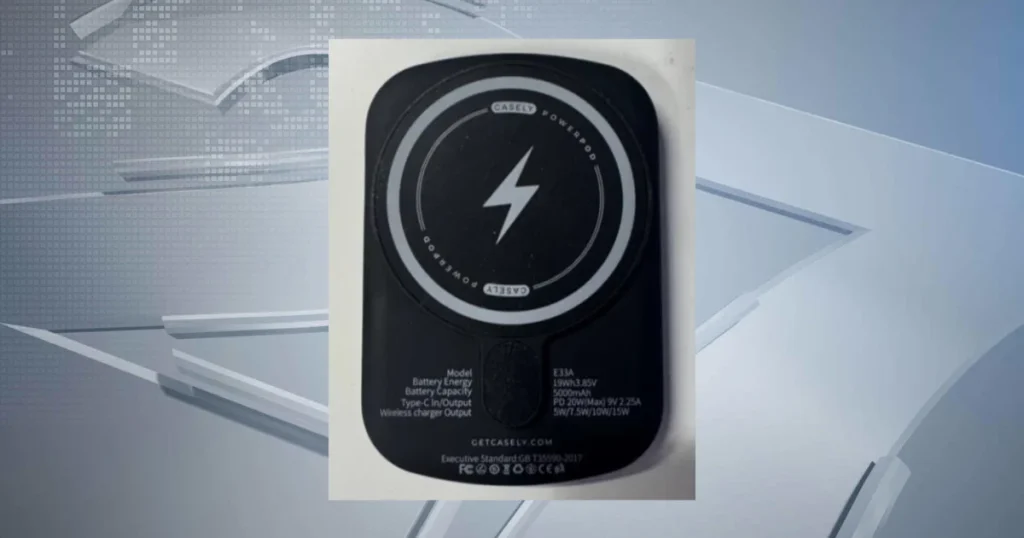
Casely, a company that makes phone cases and mobile accessories, is again recalling its 5,000 mAh MagSafe Power Pods with the model number E33A, a year after an initial recall. The Power Pods, sold between March 2022 and September 2024, pose a serious risk of fire and burns and resulted in the death of a 75 year old woman in 2024. The US Consumer Product Safety Commission said that since the initial recall in April 2025, an additional 28 incidents of overheating and fires have been reported, including one on a plane. Overall, as many as 429,200 of these Power Pods, manufactured in China, are potentially affected.
What Is Being Recalled And Why
The recalled product is the Casely 5,000 mAh MagSafe Power Pod with model number E33A. These power banks were sold between March 2022 and September 2024. The Power Pods contain lithium ion batteries, which can overheat and combust. Following numerous incidents of power banks and portable chargers overheating, some airlines have changed their policies and will implement new restrictions. One airline is allowing customers to carry only one portable battery pack per flight and restricting where the pack can be stored and how it can be charged during the flight. Casely and the safety commission are asking those who still own the Power Pods to stop using them immediately and submit a claim for a free replacement at Casely’s website.
The Science Of Why This Keeps Happening
Lithium ion batteries are the most commonly used rechargeable battery type. They are used in phones, electric vehicles, electric bikes and scooters, smartwatches, laptops, portable speakers, toys, and vaping devices. They became popular because they are cheap, energy dense, and have a fairly long lifecycle. However, they can go wrong when they overheat and combust. This can be caused by a number of factors. If they short circuit, that can generate high temperatures and, when coupled with high pressure in some types of cells or devices, can even trigger an explosion.
Some of those precipitating factors include problems at the manufacturing stage, such as inconsistencies or imperfections in the cells’ construction, especially if components are faulty or not reinforced. A professor of chemistry explained that lithium ion batteries have several layers of complications that can lead to problems. When components in a lithium ion cell come into contact because the separators are too thin or damaged, it can cause a short circuit and lead to overheating. The overheating can lead to combustion. These batteries have flammable organic components such as carbonate electrolytes, and they can catch on fire in the presence of high temperatures.
Incidents And Deaths Since The First Recall

Since the initial recall in April 2025, an additional 28 incidents of overheating and fires have been reported. One of these incidents occurred on a plane, raising serious safety concerns for air travel. The most tragic outcome was the death of a 75 year old woman in 2024 related to a Power Pod fire. Overall, as many as 429,200 units are potentially affected by this recall. Other companies have had similar recalls in recent years over portable battery products that posed fire and burn risks.
Solutions To Overheating Lithium Ion Batteries
One way to avoid the danger of fiery batteries is to avoid products that have been recalled. You should also keep an eye on battery powered devices when they are in potentially unsafe environments, such as airplanes or extreme climates. Some researchers are hoping improved materials or entirely different types of batteries will help mitigate risks in the future. Research projects have the common goal of developing alternative electrolytes that are not flammable. The battery industry is also interested in developing better predictive and diagnostic tools to prevent fires and explosions.
What Owners Should Do Now
If you own a Casely 5,000 mAh MagSafe Power Pod with model number E33A, stop using it immediately. Do not charge it, do not carry it, and do not leave it plugged in. Submit a claim for a free replacement at Casely’s website. The company is offering free replacements to all affected customers. If you are unsure whether your device is affected, check the model number on the back or bottom of the power bank.
Pros And Cons
Pros
- Casely is offering free replacements to affected customers
- The recall notice clearly instructs users to stop using dangerous units immediately
- Airlines are implementing new safety policies to prevent in flight fires
- Researchers are developing non flammable battery alternatives
- The safety commission is publicly tracking incidents and deaths
Cons
- This is the second recall for the same product, indicating persistent safety issues
- 28 new incidents occurred after the first recall, meaning many users did not stop using dangerous units
- One death and one plane fire have been reported
- As many as 429,200 units are potentially affected
- Lithium ion battery risks remain poorly understood by many consumers
- Airline restrictions now limit travelers to one power bank per flight
Frequently Asked Questions (FAQs)
1. Which Casely product is being recalled?
The Casely 5,000 mAh MagSafe Power Pod with model number E33A, sold between March 2022 and September 2024.
2. Why is the Power Pod being recalled?
The lithium ion batteries inside can overheat, catch fire, and cause burns or death. There have been 28 new incidents since the first recall, including one death.
3. How many units are affected?
As many as 429,200 Power Pods are potentially affected.
4. What should I do if I own a recalled Power Pod?
Stop using it immediately and submit a claim for a free replacement at Casely’s website.
5. Has anyone been hurt?
Yes, a 75 year old woman died in 2024, and 28 additional incidents including overheating and fires have been reported since the first recall.
6. Why do lithium ion batteries catch fire?
They contain flammable components and can short circuit if separators are too thin or damaged, leading to overheating and combustion.
7. Are airlines changing their rules about power banks?
Yes, at least one airline will now allow only one portable battery pack per flight and restrict where it can be stored and how it can be charged during the flight.