



Table of Contents
Introduction
Sea-Gull is a name that divides the watch community more sharply than almost any other. On one side, it is China’s first watch brand, a state-backed manufacturer with a genuine military history and the vertical integration to produce its own movements, hairsprings, and escapements in-house. On the other, it is a brand that many Western collectors still associate with the “cheap Chinese watch” stereotype, despite movements that power watches far more expensive than its own. The Seagull 1963 chronograph, in particular, has become a cult classic, praised for offering a column-wheel chronograph for a fraction of the Swiss price.
This review looks at what Sea-Gull actually offers in 2026, where the value is genuine, where the compromises show, and whether the brand deserves a place in a serious collection.
What Is Sea-Gull?
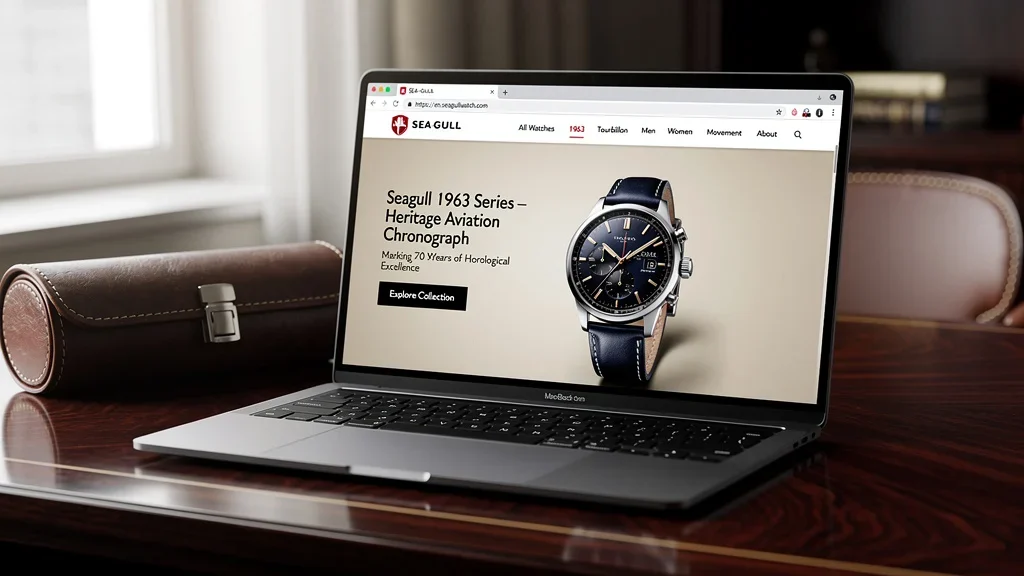
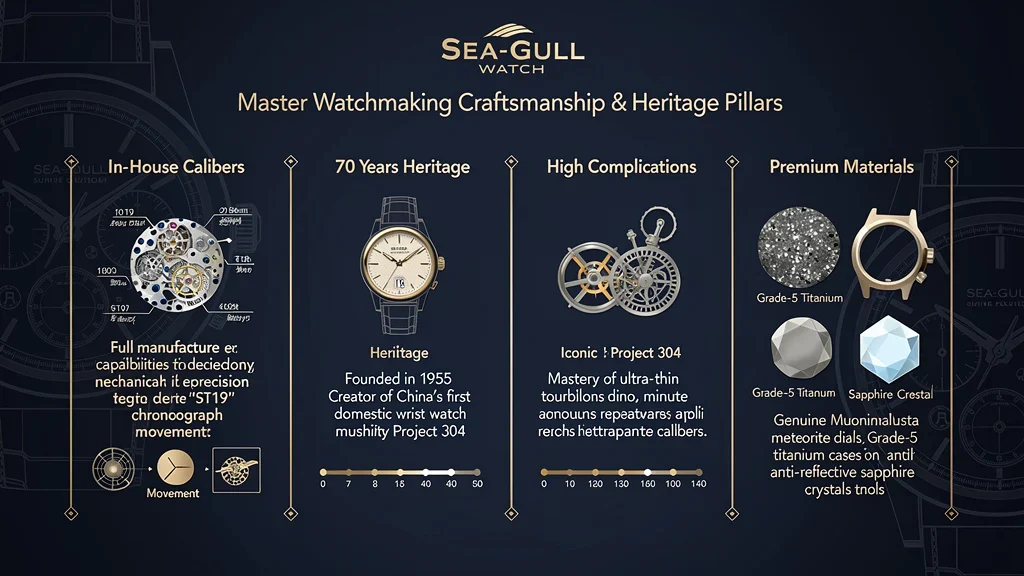
Sea-Gull is a watch manufacturer based in Tianjin, China, and the country’s oldest and most historically significant watch brand. The story begins in 1955, when the Tianjin Watch Factory produced the “Five-Star,” China’s first domestically manufactured watch. That was followed by the “Dongfeng” (East Wind) in 1966, China’s first domestically designed timepiece, and the brand was renamed Sea-Gull in 1973 for export markets.
Key aspects of the brand include:
- Founded in 1955 as the Tianjin Watch Factory, renamed Sea-Gull in 1973
- China’s first watch brand and first watch exporter
- Vertically integrated movement manufacturer, producing roughly 25% of global mechanical movements
- Developed China’s first military aviation chronograph, Project 304, in the 1960s
- Operates over 200 retail and experience stores in China and exhibits at Baselworld
- Offers a wide range from entry-level automatics to tourbillons and split-seconds chronographs
The brand’s identity is built on two pillars: historical legitimacy and manufacturing capability. It is not a fashion brand that outsources its movements. It is a movement maker that also sells watches.
The Product Line: What Sea-Gull Actually Sells
Sea-Gull’s catalogue is unusually broad for a brand at its price point, spanning military reissues, dive watches, dress watches, and high-complication pieces.
The 1963 Chronograph is the brand’s signature line. It is a reissue of the Project 304 aviation chronograph developed for the Chinese Air Force, powered by the ST19 manual-wind column-wheel movement. The 1963 collection now includes multiple versions, from the purist reissue to meteorite-dial editions priced up to ¥8,980.
The Ocean Series is the brand’s dive watch line. The 1984 Antarctic Expedition edition is a 40mm automatic diver with 200m water resistance, a sapphire crystal, and the ST2130 movement. The 6203 “Squid” is another Ocean Series model, with a textured wave dial and a 5.0/5 rating from 20 reviews on Sea-Gull’s site.
The Basic Series covers everyday automatics, often using the ST2130. These are the entry point to the brand and the models most often compared to entry-level Swiss and Japanese automatics.
High Complications include tourbillons starting at around $1,400 and a split-seconds chronograph at $3,400, both of which undercut Swiss equivalents by orders of magnitude.
| Series | Key Models | Movement | Price Positioning |
|---|---|---|---|
| 1963 Chronograph | 1963 Reissue, Meteorite editions | ST19 manual column-wheel | Mid-range |
| Ocean Series | 1984 Antarctic, 6203 Squid | ST2130 automatic | Mid-range |
| Basic Series | D816.405, D302T | ST2130 automatic | Budget to Mid |
| High Complications | Tourbillon, Split-Seconds | ST80, ST1961 | Premium (for the brand) |
Build Quality and Materials
Build quality is where Sea-Gull’s reputation is most polarized, and the honest answer is that it depends on the model and the price point.
What reviewers consistently praise:
- The ST19 chronograph movement is genuinely beautiful, with a column wheel and horizontal clutch visible through the sapphire case back. One review notes that “there is no rotor to hide the gears, making it one of the most beautiful movements you can find for under $1,000”.
- The Ocean Series uses 316L stainless steel with a mix of brushed and polished surfaces, a sapphire crystal, and a unidirectional bezel. Owners describe the finish as rivalling “much more expensive brands”.
- The ST2130 automatic is widely respected as a reliable workhorse, running at 28,800 vph with a 42-hour power reserve and 28 jewels.
Where the compromises show:
- A Chinese-language review of the Basic Series D816.405 notes that while the weight feels good, “the workmanship still has a relatively large gap compared to Swiss watches,” likely due to the price.
- An eBay reviewer of a 1963 model described it as “an unreliable watch” that stopped functioning after fewer than five uses and seven months in a drawer.
- The Ocean Series 6203’s clasp and dive extension are stamped steel rather than solid steel, a detail one owner noted as a “bémol” (drawback).
The pattern is that Sea-Gull’s movements are excellent for the price, and the cases and finishing are good but not Swiss-level. Buyers who expect a $300 watch to feel like a $3,000 watch will be disappointed. Buyers who expect a $300 watch to feel like a very good $300 watch will be satisfied.
Design and Real-World Experience
Sea-Gull design language is one of its strongest assets, particularly in the heritage lines.
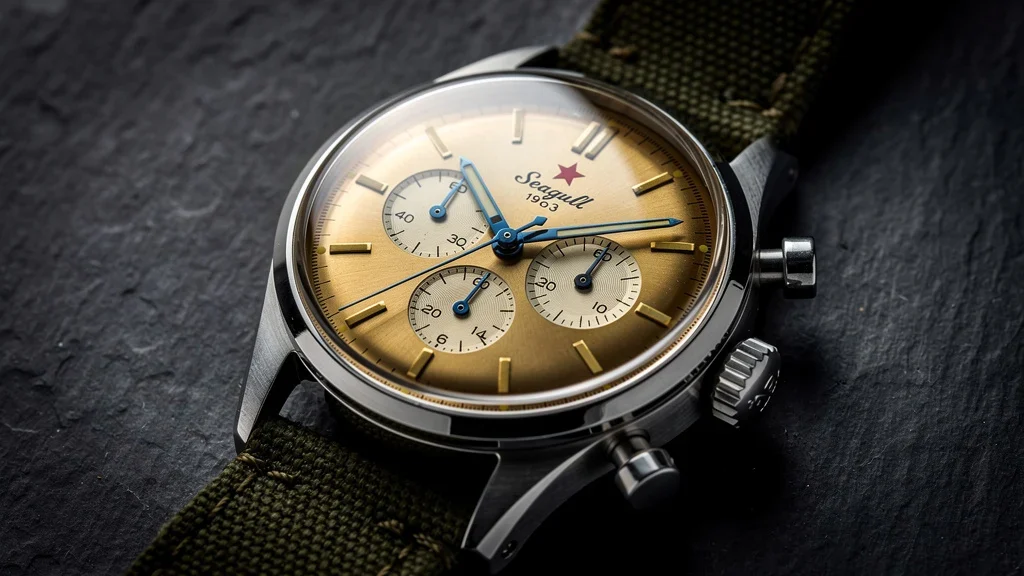
The 1963 is the standout. The champagne dial, red star, and blue hands are instantly recognizable, and the decision to keep the dial free of English branding (using original Chinese characters instead) gives it an authenticity that Western collectors appreciate. The 38mm case is faithful to the original proportions.
The Ocean Series is more conventional but well-executed. The 40mm case, 49mm lug-to-lug, and 15mm thickness give it a substantial wrist presence without being oversized. The wave-pattern dial on the 6203 is a distinctive touch that owners describe as looking “absolutely incredible without being too loud”.
Performance: Does the Movement Deliver?
Performance is where Sea-Gull’s vertical integration pays off, and independent feedback is largely positive.
The ST19 chronograph is a manual-wind, column-wheel design with 22 jewels, a 21,600 vph frequency, and roughly 40 hours of power reserve. It is a derivative of the Swiss Venus 175, manufactured domestically since the 1960s. The column wheel gives it a crisper pusher feel than the cam-actuated movements found in most chronographs at this price.
The ST2130 automatic is the brand’s workhorse. It runs at 28,800 vph with 28 jewels and a 42-hour power reserve. Owners report accuracy in the range of +4 to +8 seconds per day, which is excellent for the price.
The limitations are equally real. One eBay reviewer reported a watch that stopped functioning after minimal use, suggesting that quality control is not perfect. Another owner noted that the Ocean Series runs “a tick on the fast side” but considered it acceptable.
| Movement | Type | Frequency | Power Reserve | Reported Accuracy |
|---|---|---|---|---|
| ST19 | Manual column-wheel chronograph | 21,600 vph | ~40 hours | Good for price |
| ST2130 | Automatic | 28,800 vph | 42 hours | +4 to +8 sec/day |
| ST1961 | Split-seconds chronograph | High-frequency | Varies | Competitive with Swiss |
Pricing and Value
Sea-Gull pricing is the core of its argument, and the numbers are striking.
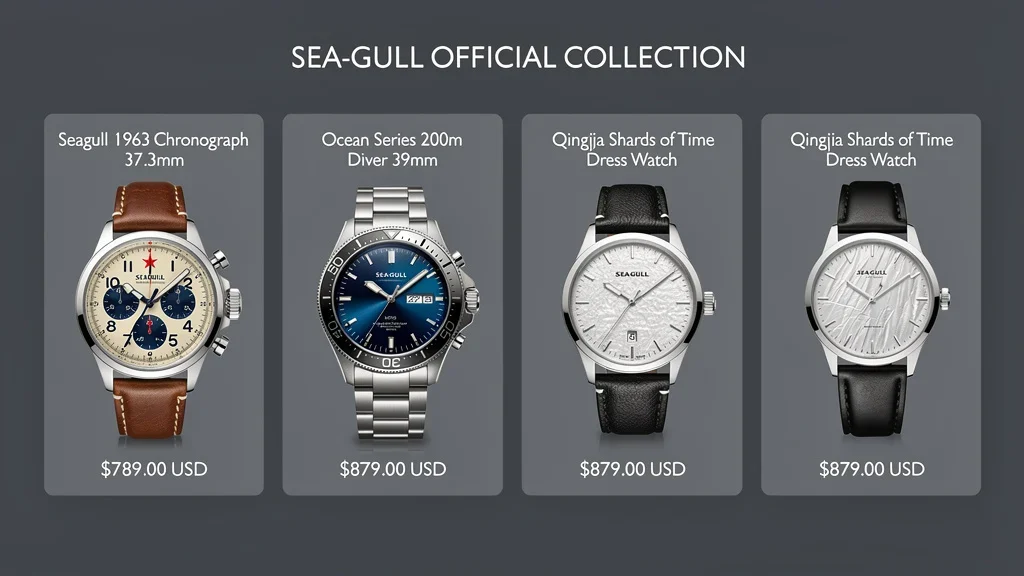
Current pricing (approximate, varies by model and region):
- Seagull 1963 reissue: around $169–$286 on the secondary market, with official versions higher
- Ocean Series 6203: competitively priced against entry-level Swiss divers
- Basic Series automatics: budget-friendly
- Tourbillons: starting around $1,400
- Split-seconds chronograph: $3,400
| Product | Sea-Gull Price | Swiss Equivalent |
|---|---|---|
| 1963 Chronograph | ~$200–$500 | $1,000+ |
| Ocean Series Diver | ~$300–$600 | $800–$1,500 |
| Tourbillon | ~$1,400+ | $100,000+ |
| Split-Seconds | ~$3,400 | $200,000+ |
The value case is strongest for the 1963 and the complications. A column-wheel chronograph with genuine military history for under $500 is difficult to argue with. A tourbillon for $1,400 is, on paper, extraordinary.
The value case is weaker for the Basic Series, where Japanese and entry-level Swiss brands offer more consistent quality control and stronger after-sales support at similar prices. Sea-Gull’s advantage is in the complications and the heritage, not in the generic everyday watch.
Customer Experience and Reputation
Sea-Gull’s customer experience is a mixed picture, with product satisfaction generally high but independent review data limited.
Positive feedback highlights:
- “Great watch with an amazing dial. Very easy to set up and use. 4th watch I’ve bought from Sea-Gull, each one is spot on!” — verified review on Sea-Gull’s site
- “What a wonderful watch for the price… great customer service from Sea Gull (this is my third watch from them)”
- “I had high expectations and the watch absolutely exceeded them. Secondly, the customer service was second to none”
- “Excellent quality! Quite impressive with its timekeeping!” — eBay reviewer
Concerns to note:
- “An unreliable watch. Unfortunately this watch has stopped functioning after only a few uses” — eBay reviewer
- The brand’s own review pages are curated and do not represent independent feedback at scale
- Independent review data on Trustpilot and similar platforms is limited, making it harder to assess how the brand handles defects
The pattern suggests that most buyers are satisfied, particularly with the 1963 and Ocean Series, but that quality control is not perfect and the brand’s support experience outside China is not well documented.
Pros and Cons
| Pros | Cons |
|---|---|
| Genuine historical legitimacy as China’s first watch brand | Quality control is inconsistent across models |
| In-house movements, including column-wheel chronographs | Finishing is good but not Swiss-level |
| Exceptional value on complications (tourbillon, split-seconds) | Some models have stamped rather than solid components |
| The 1963 is a genuine design icon with military provenance | No lume on the 1963, limiting daily usability |
| ST2130 is a reliable, accurate workhorse automatic | Limited independent review data outside China |
| Strong value on dive watches with sapphire and 200m rating | After-sales support outside China is not well documented |
| Vertically integrated manufacturing at scale | Brand perception still lags in Western markets |
Sea-Gull vs. Standard Brands
How does Sea-Gull compare to the brands it is most often measured against?
| Feature | Sea-Gull | Seiko | Tissot | Hamilton |
|---|---|---|---|---|
| Entry Automatic Price | ~$200–$400 | ~$200–$400 | ~$400–$600 | ~$500–$800 |
| In-House Movement | Yes | Yes | Some | Some |
| Chronograph Movement | Column-wheel (ST19) | Cam-actuated | Quartz or automatic | Automatic |
| Tourbillon | ~$1,400+ | Not offered | Not offered | Not offered |
| Heritage | 1955, China’s first watch | 1881, Japan | 1853, Switzerland | 1892, USA |
| Quality Consistency | Variable | Excellent | Excellent | Excellent |
| After-Sales Support | Limited outside China | Strong | Strong | Strong |
| Best For | Heritage and complications on a budget | Everyday reliability | Swiss pedigree at mid-range | American heritage at mid-range |
Sea-Gull’s unique position is that it offers complications and heritage that no brand at its price can match. Seiko and Tissot offer better consistency and support. The choice depends on whether you value the movement and the story or the ownership experience.
Verdict and Final Thoughts
Sea-Gull is a brand that deserves more respect than it often receives, and more caution than its most enthusiastic fans sometimes acknowledge.
The strengths are real. The 1963 is a genuine icon, with military provenance, a beautiful column-wheel movement, and a design that has aged remarkably well. The Ocean Series offers a legitimate dive watch with sapphire, 200m water resistance, and an accurate ST2130 automatic at a price that undercuts the Swiss competition. The complications, particularly the tourbillon and split-seconds, are extraordinary value on paper.
The weaknesses are equally real. Quality control is inconsistent. The finishing is good for the price but not Swiss-level. The brand’s after-sales support outside China is not well documented. And the perception gap, however unfair, still affects resale value and mainstream acceptance.
Who is Sea-Gull best for?
- Watch enthusiasts who want a column-wheel chronograph with genuine heritage on a budget
- Collectors interested in the history of Chinese watchmaking
- Buyers who prioritize movement and design over brand prestige
- Anyone curious about complications without spending five figures
Who should look elsewhere?
- Buyers who prioritize consistent quality control and strong after-sales support
- Anyone who wants a watch with strong resale value
- People who are uncomfortable with the variability of a budget Chinese brand
- First-time automatic buyers who want a worry-free ownership experience
Overall, Sea-Gull is worth exploring, particularly the 1963 and the Ocean Series. The brand delivers genuine horological value that few competitors can match. But buy with realistic expectations, and if you are ordering internationally, understand the return and warranty process before you commit.
Considering Sea-Gull? Start with the 1963 or an Ocean Series diver, buy from a reputable seller with a clear return policy, and judge the watch on its own merits rather than its badge.
Scorecard
| Category | Rating |
|---|---|
| Heritage & Design | ⭐⭐⭐⭐⭐ |
| Movement Quality | ⭐⭐⭐⭐½ |
| Build Quality | ⭐⭐⭐½ |
| Value for Money | ⭐⭐⭐⭐⭐ |
| Quality Consistency | ⭐⭐⭐⭐ |
| After-Sales Support | ⭐⭐⭐⭐ |
| Overall Rating | 4.2/5 |