If you’re shopping for a new TV, you’ve probably seen two terms everywhere: QLED and OLED. They sound similar, but they’re actually completely different technologies. So which one is better? Let’s break it down.
What Is QLED?
QLED stands for “quantum dot LED TV.” But here’s the truth: a QLED TV is really just an LCD TV with an extra layer of quantum dots. Samsung started using this branding in 2017, and now TCL, Vizio, and Hisense also make quantum dot TVs (though only Samsung calls them QLED).
Here’s how it works:
- An LED backlight shines light through a quantum dot film
- The quantum dots create different colors
- The light then passes through a liquid crystal (LCD) layer
- Finally, it reaches the screen
Because light passes through multiple layers, we call this a “transmissive” display. Most QLED TVs today are actually mini-LED or full-array LED TVs, which helps improve contrast.
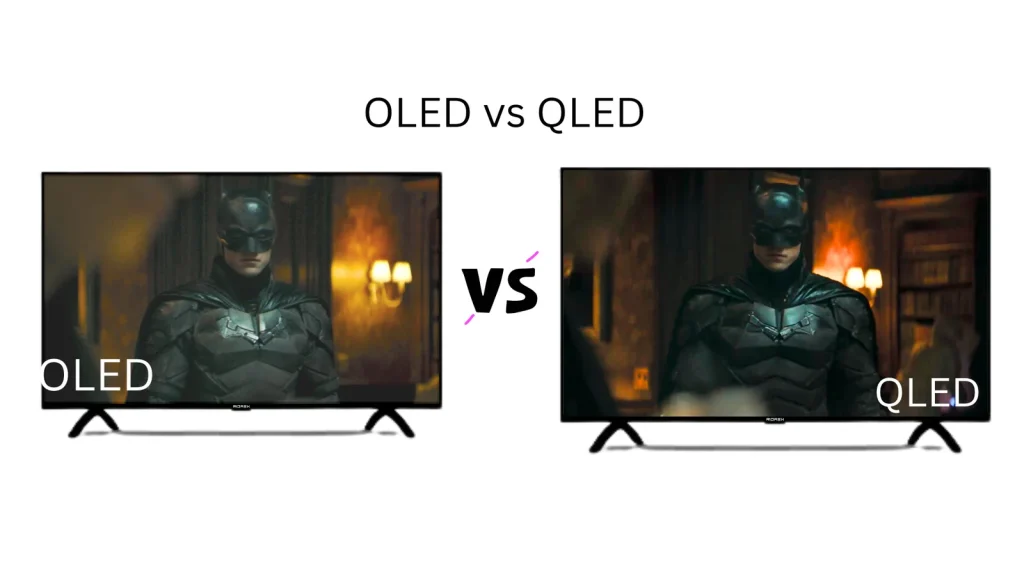
What Is OLED?
OLED stands for “organic light-emitting diode.” Unlike QLED, OLED is not an LCD TV at all. It works completely differently.
Here’s the key difference:
- Each pixel in an OLED TV produces its own light
- There’s no backlight
- When a pixel is turned off, it’s completely black
This is called an “emissive” display. LG has dominated OLED for years, but now Samsung makes its own OLED panels using QD-OLED technology (quantum dot OLED). Sony and Panasonic also sell OLED TVs.
Quick Summary of Differences
| Feature | QLED | OLED |
|---|---|---|
| Technology | LCD with quantum dots | Organic light-emitting diodes |
| Light source | LED backlight (transmissive) | Self-emissive pixels |
| Black level | Good, but not perfect | Perfect (pixels turn off completely) |
| Brightness | Very bright | Good, but not as bright as QLED |
| Viewing angles | Fade at an angle | Excellent from almost any angle |
| Screen uniformity | Can have uneven areas | Almost perfectly uniform |
| Sizes available | 32 to 115 inches | 42 to 97 inches |
| Price for 65-inch | More affordable | More expensive |
| Burn-in risk | Very low | Possible with static images |
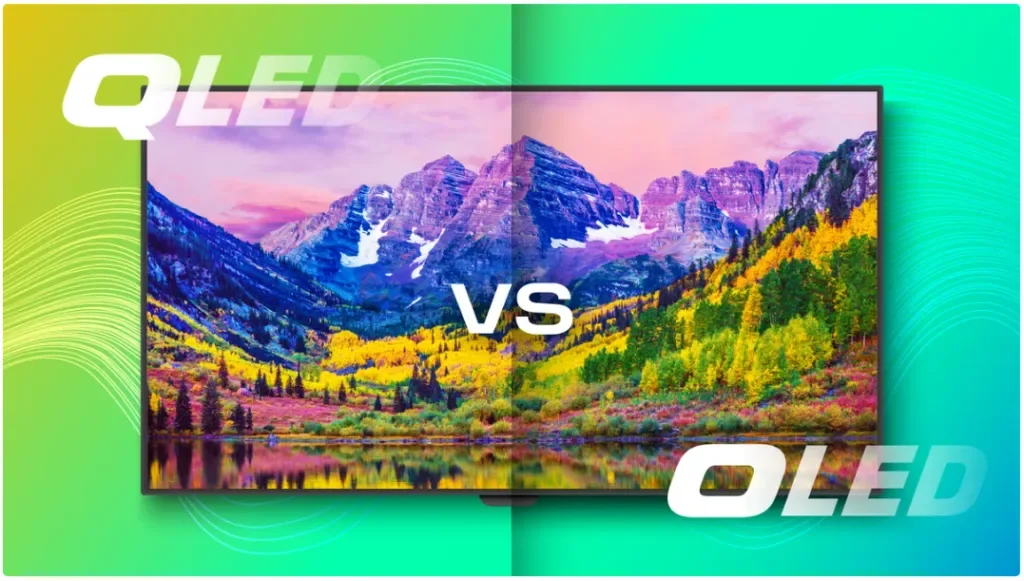
Picture Quality: Which Is Better?
Contrast and black level: OLED wins. Because OLED pixels turn off completely, black is truly black. This gives OLED infinite contrast. Even the best QLED TVs with mini-LED backlights can’t match that. The new TCL QM8K gets close, but OLED is still the king of contrast.
Brightness: QLED wins. The brightest QLED TVs get significantly brighter than any OLED. This is great for bright rooms or watching HDR content. That said, most OLED TVs are bright enough for normal living rooms. And because OLED has better contrast, it often still looks better overall.
Viewing angles: OLED wins. QLED TVs fade and lose color when you watch from an angle. OLED TVs look almost the same from any seat in the room.
Uniformity: OLED wins. Some QLED TVs have uneven brightness across the screen. OLED screens are nearly perfectly uniform.
Color and resolution: Both are good. Both technologies can produce accurate colors and 4K resolution. QD-OLED (Samsung’s OLED) delivers especially good color. But in general, neither has a major advantage here.
Sizes and Prices
OLED sizes available: 42, 48, 55, 65, 77, 83, 88, and 97 inches.
QLED sizes available: 32, 43, 50, 55, 58, 65, 75, 82, 85, 98, 100, and 115 inches.
If you want a TV larger than 77 inches, QLED is usually much cheaper. A 77-inch OLED costs $2,200 or more. A 75-inch QLED can cost significantly less. For smaller sizes (under 55 inches), QLED is also more common and affordable.
What About OLED Burn-In?
Burn-in happens when a static image (like a news ticker or channel logo) leaves a permanent ghost on the screen. OLED TVs can get burn-in. QLED TVs are much less susceptible.
But here’s the honest truth: burn-in isn’t a problem for most people. If you watch varied content and don’t leave Fox News, ESPN, or a video game HUD on the screen for 10 hours a day, you’ll probably never see burn-in. Still, if you’re worried about it, QLED is safer.
Which Should You Buy in 2026?
If picture quality is your top priority, OLED is better. Every time. OLED TVs have better contrast, better viewing angles, and more lifelike images. They win in side-by-side comparisons.
But QLED is still a great choice. Go with QLED if:
- Your room is very bright (lots of windows)
- You want a TV larger than 77 inches
- You’re on a tighter budget
- You’re worried about burn-in
- You watch a lot of news or sports with static logos
What About the Future?
Samsung is working on “emissive QLED” – a version of QLED that doesn’t need a backlight. That could match OLED’s perfect blacks while being brighter and more efficient. But it’s still a few years away.
MicroLED is another technology. It’s emissive like OLED, has perfect blacks, no burn-in, and gets incredibly bright. But it’s extremely expensive (over $1 million for the biggest models). That’s not realistic for most people yet.
The Bottom Line
For most people in 2026, OLED is the better choice for picture quality. But QLED is brighter, cheaper in large sizes, and has no burn-in risk. The right choice depends on your room, your budget, and what you watch.
If you can afford it and want the best image, get an OLED. If you want a giant TV or have a very bright room, get a QLED. Either way, both technologies are excellent.