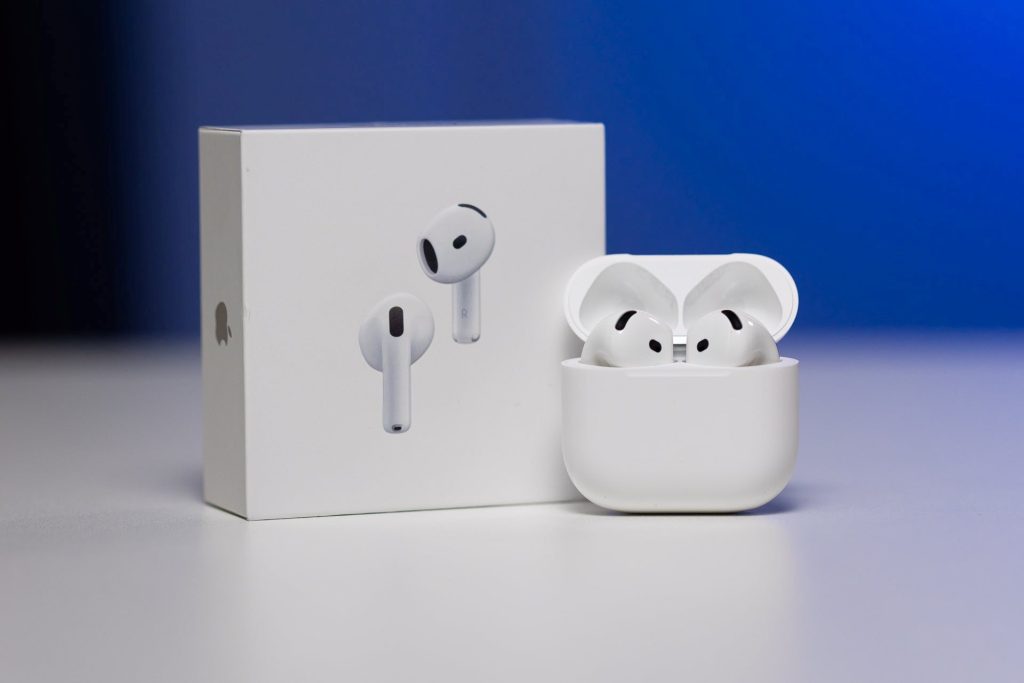
The fourth-generation AirPods 4 mark a significant leap forward for Apple’s entry-level earbuds. With a slightly smaller design, improved sound quality and the powerful H2 chip, they offer a worthy upgrade over their predecessors. However, the real headline feature is the inclusion of active noise canceling in the step-up model—a first for an open-design earbud. Starting at $129 for the standard version and $179 for the ANC model, Apple has successfully bridged the gap between its basic and Pro lineups, creating a compelling option for a wide range of users.
Design and Fit: Refined and More Comfortable
The AirPods 4 retain the beloved open-ear design of their predecessors but with subtle yet meaningful improvements that enhance both comfort and portability.
A smaller case and a better fit for more ears
The charging case for the AirPods 4 is now smaller than the AirPods 3’s case, making it even easier to slip into a pocket. The earbuds themselves have been slightly redesigned to fit more ears securely. They are slightly smaller than the AirPods 3 but slightly bigger than the AirPods 2. This refinement addresses one of the biggest complaints about previous open-ear models: the struggle to find a secure fit.
No ear tips, no problem
For many users, the absence of silicone ear tips is the primary selling point. The open design allows for extended wear without the ear fatigue often associated with in-ear monitors. While this design is more comfortable for long listening sessions, it does have a fundamental acoustic drawback: it creates an open seal, which directly impacts the effectiveness of the noise cancellation.
Active Noise Cancellation: The Game-Changing Feature
The inclusion of ANC in an open-ear earbud is a technical marvel, but it comes with important caveats that potential buyers need to understand.
Real ANC, but with physical limits
The AirPods 4 with ANC are the first open earbuds I’ve tried where the noise canceling actually works. For daily distractions like office chatter, the hum of an air conditioner, or the rumble of a train, the ANC is highly effective. It’s a game-changer for people who want to block out the world without shoving silicone tips into their ear canals.
However, the laws of physics cannot be entirely overcome. Because the AirPods 4 lack a physical seal, their noise cancellation is roughly 40% less effective than the AirPods Pro 2. The Pro model’s silicone tips work in tandem with the H2 chip to create a superior barrier, making them essential for loud environments like airplanes.
A technical contradiction
The AirPods 4’s active noise cancellation is a technical contradiction. The semi-open structure naturally leaks sound, and while Apple uses acoustic algorithms to compensate, the results have a ceiling. The suppression of low-frequency rumbles is about 30% weaker than some competitors, and the gap is even wider for isolating human speech. So, while it’s a groundbreaking feature for open earbuds, it’s not a replacement for the Pro model’s physical noise isolation.
Audio Quality and Performance: Powered by the H2 Chip
The AirPods 4 benefit significantly from the inclusion of the same H2 chip found in the AirPods Pro 2, unlocking features that were previously exclusive to the premium line.
Rich sound with improved bass
Thanks to a new acoustic architecture and the H2 chip’s processing power, Apple says the sound quality has improved. The result is clearer highs and richer bass than any previous entry-level AirPods model. However, the lack of an acoustic seal limits immersion, and they cannot quite match the low-end punch of the Pro 2. For most casual listeners, the sound will be a significant step up and more than satisfactory.
Excellent voice calling and smart features
The voice-calling performance is top-notch, rivaling Samsung’s Galaxy Buds 3 Pro. The H2 chip also enables features like Personalized Spatial Audio with dynamic head tracking, making movies and music more immersive. It’s worth noting that features like Adaptive Audio and Conversation Awareness are only supported on the higher-end AirPods 4 with ANC, as they require noise canceling and transparency modes to function.

Battery Life and Charging: A Minor Trade-Off
To make room for the new technology, Apple had to make a small compromise on battery life.
Shorter playtime, but enough for a day
One disappointing aspect is that Apple wasn’t able to improve on battery life; in fact, it’s slightly worse than the AirPods 3. With noise canceling off, you get up to 5 hours of listening time. With ANC on, that drops to 4 hours. The case provides additional charges, offering up to 25 hours of total listening time with ANC off and 16 hours with it on.
Convenient charging options
The higher-end AirPods 4 model features a case with a built-in speaker for Find My functionality and supports wireless charging via Qi pads or the Apple Watch charger. The standard model lacks wireless charging. Both models use USB-C for wired charging.
Pricing and Final Verdict: Which Model Should You Choose?
With two models available, the choice ultimately comes down to how much you value noise cancellation and smart features.
Standard AirPods 4 ($129)
The standard AirPods 4 are essentially slightly smaller versions of the AirPods 3 with better sound quality and the benefits of the more powerful H2 chip. If you’ve never wanted or needed noise canceling, this is a fantastic upgrade that will likely see discounts to around $100 during sales.
AirPods 4 with ANC ($179)
The ANC model is the more special of the two. For an extra $50, you get real, working noise cancelation in an open-ear design. They are essentially the AirPods Pro 2 for people who don’t like having ear tips jammed in their ears. However, if you need maximum noise isolation for frequent flights, the AirPods Pro 2 remain the superior choice and are getting exclusive hearing-aid features.