



Table of Contents
Introduction
Saguaro has become one of the first names people encounter when they start looking into barefoot shoes. The brand’s appeal is straightforward: zero-drop soles, wide toe boxes, and flexible construction at prices that sit far below established players like Vivobarefoot or Xero Shoes. With thousands of reviews across its product pages and a presence on Amazon marketplaces across Europe, Saguaro has built a volume business on accessibility rather than prestige. But low prices often come with trade-offs. This review looks at what Saguaro actually delivers, where the savings show up, and whether the brand is a genuine entry point into barefoot footwear or a false economy.
What Is Saguaro?
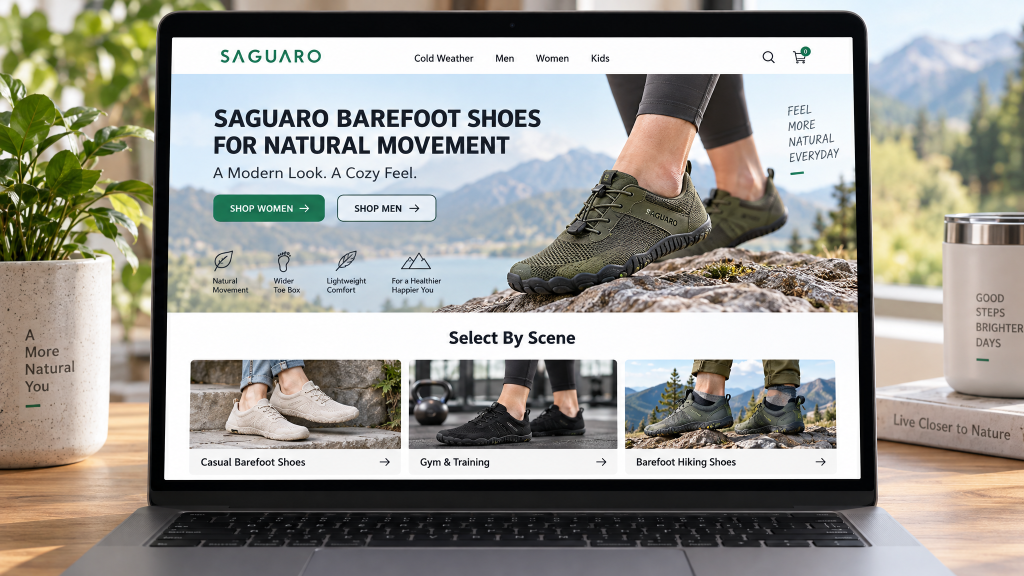
Saguaro is a barefoot shoe brand that focuses on minimalist footwear for adults and children. The company’s catalog covers casual shoes, training shoes, dress shoes, kids’ models, and seasonal options like rain boots. The core design principles are consistent across the range: a zero-drop sole, a wide toe box that lets toes spread naturally, and a flexible build that aims to mimic the feeling of walking barefoot.
Key aspects of the brand include:
- Zero-drop soles across the product range
- Wide toe boxes designed for natural foot movement
- Lightweight construction, often under 300 grams per shoe
- Natural rubber outsoles on many models
- Prices typically ranging from around $30 to $80 depending on the model and region
- A large catalog with frequent new releases and colorways
Saguaro positions itself as an accessible entry point into barefoot footwear, and that positioning is reflected in both its pricing and its design choices.
Product Range and What Each Line Is For
Saguaro’s catalog is broad enough that the model names can blur together. Mapping the range to actual use cases makes the lineup easier to navigate.
Casual and Everyday Models: The Luck series is the brand’s casual staple, with models like the Luck I rated 4.4/5 from nearly 2,400 reviews. These are the shoes for everyday wear, walking, and casual outfits. They are not designed for intense training.
Training and Active Models: The Smart series targets gym work, walking, and light activity. The Smart II holds a 4.6/5 rating from over 5,300 reviews, with users praising the elastic laces and barefoot feel. The Active series is positioned as more durable for hiking and trail use.
Dress and Formal Models: The Noble series attempts to bring barefoot geometry to formal footwear. The Noble II is rated 4.2/5 from 267 reviews, with feedback noting comfort for long walking but also complaints about fabric wear and a somewhat unconventional shape.
Kids’ Models: Saguaro offers an extensive children’s range, including the Free I and Vitality series. The Kid’s Free I is rated 4.6/5 from 373 reviews, with parents praising flexibility and durability. The kids’ range is one of the brand’s stronger categories.
Seasonal and Specialty Models: The Brisk rain boots and various slip-on and water-friendly models round out the catalog.
| Model Line | Primary Use | Standout Feature | Review Rating |
|---|---|---|---|
| Luck | Casual, everyday | Simple, affordable barefoot basics | 4.4/5 (2,399 reviews) |
| Smart | Training, walking | Elastic laces, breathable knit | 4.6/5 (5,355 reviews) |
| Noble | Formal, business casual | Dress shoe styling with barefoot geometry | 4.2/5 (267 reviews) |
| Active | Hiking, trail | More durable construction | — |
| Kid’s Free | Children’s everyday | Flexible, wide fit for kids | 4.6/5 (373 reviews) |
Build Quality: What the Savings Actually Cost
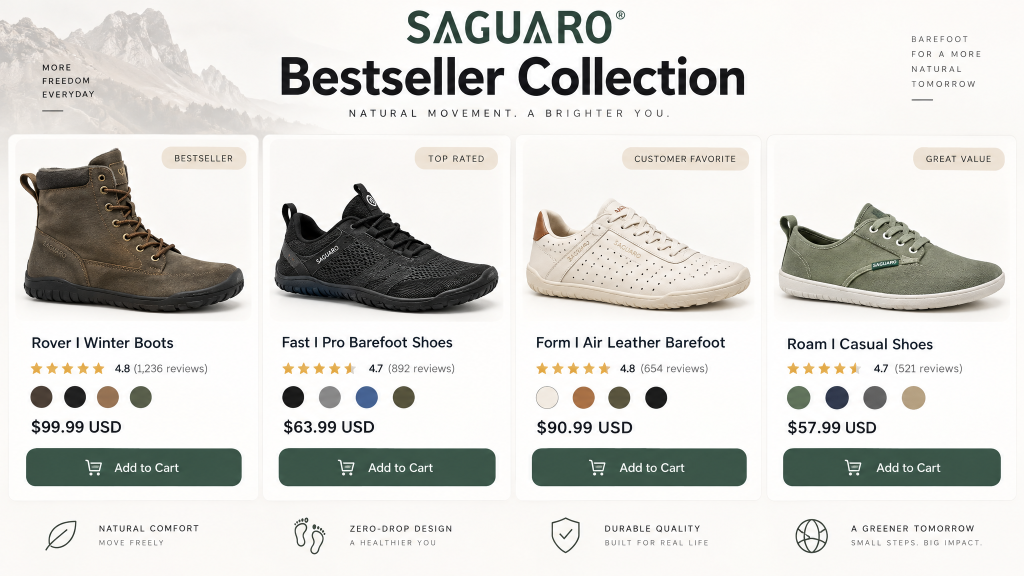
This is where the Saguaro story becomes more nuanced. The brand’s prices are low, and for many buyers the shoes perform well enough for the money. But the materials and construction reflect the price point.
What holds up: The outsoles are generally praised. Natural rubber is used on many models, and users report good grip and reasonable tread life. One long-term user noted their first pair lasted around 365 miles. The uppers on knit models are breathable and comfortable, and the wide toe box is consistently described as genuinely wide rather than cosmetically wide.
What does not always hold up: Durability is the most common complaint. A review of the Noble II noted fabric wear and “glue like dust” after just five days of use. A children’s model review mentioned the elastic strap failing in less than a week. A German Amazon review of a kids’ model noted poorly glued rubber on the sides peeling away. And a French reviewer who had bought Saguaro for years stated that quality has declined, with newer pairs not lasting as long as older ones.
The pattern is not that Saguaro shoes fall apart immediately. Most reviews describe them as durable enough for casual use. The issue is consistency: some pairs last well, others show premature wear, and the finish details (glue lines, stitching) are visibly budget-grade.
| Aspect | What Users Report |
|---|---|
| Outsoles | Generally good grip; tread life varies |
| Uppers (knit) | Breathable, comfortable, but can wear |
| Uppers (dress models) | Fabric wear and glue dust reported |
| Construction details | Visible glue lines on some models |
| Longevity | Around a year for many users; inconsistent |
Sizing and Fit: The Most Important Thing to Get Right
Saguaro‘s sizing is one of the most frequently discussed topics in reviews, and for good reason. Getting the size wrong is the fastest way to dislike a barefoot shoe.
General sizing guidance: Saguaro recommends choosing your usual size, but the brand’s sizing is not always consistent across models. Reviews frequently mention sizing up or down depending on the shoe:
- The Luck I: One reviewer who normally wears a 40.5 or 41 found size 40 “just right”. Another noted size 39 fits a 24.5cm foot.
- The Noble II: A reviewer with wide feet found that a size larger than their usual 44 would have been better.
- Kids’ models: A parent noted Saguaro kids’ sizes run “significantly shorter” than equivalent US toddler sizes.
The practical takeaway is that Saguaro’s sizing is not uniform across the catalog. Checking the specific product page’s size guidance and reading recent reviews for that exact model is more reliable than assuming your usual size will translate.
Toe box width: The wide toe box is the brand’s strongest fitting feature. Reviewers with wide feet and bunions consistently praise the roominess. However, a few reviewers note that the toe box, while wide, may not be wide enough for every foot shape, particularly for the pinky toe.
Pricing and the Value Equation
Saguaro’s pricing is its defining feature. The brand undercuts almost every established barefoot shoe company, and that price advantage is real.
Typical price ranges (depending on model and region):
- Adult casual and training models: roughly $30 to $60
- Dress models: around $70 to $80
- Kids’ models: generally $40 to $70
- Sale prices can bring adult models below $40
For context, Vivobarefoot shoes typically retail around $150 or more. The Guardian’s 2026 barefoot shoe guide named Saguaro Free I as the best budget barefoot shoe, which reflects the brand’s position in the market.
The value question depends on expectations. If you compare Saguaro to Vivobarefoot, the Saguaro shoe will feel less refined: the sole is thicker (around 5–7mm versus 3–5mm on some Vivo models), the materials are less premium, and the finishing is less precise. But at roughly one-third to one-half the price, many buyers find the trade-off acceptable, especially for a first pair or for a shoe that will be worn casually rather than daily for years.
| Comparison Point | Saguaro | Vivobarefoot |
|---|---|---|
| Typical price | $30–$80 | ~$150+ |
| Sole thickness | ~5–7mm | ~3–5mm |
| Materials | Budget to mid-range | Premium |
| Finishing | Variable | Consistent |
| Best for | First barefoot shoe, casual use | Long-term daily wear |
Warranty and Returns
Saguaro’s customer protection is stronger than its price point might suggest, but the details matter.
The brand offers a 30-day return and exchange window from delivery, with a 180-day quality guarantee on standard products. Some specific models, like the Brisk rain boots, carry a 120-day unconditional guarantee for quality issues.
The conditions are standard: items must be unused and in original packaging for returns, and return shipping costs may not be refunded unless the issue is a defect. The brand’s customer service replies to reviews appear responsive, often resolving issues with replacements or refunds when problems are documented.
The caveat is that experiences vary. One reviewer reported a defective pair and no email confirmation of their return request for over two weeks. As with any online purchase, documenting the issue and following up is important.
Customer Experience and Reputation
Saguaro‘s reputation is shaped heavily by its own review ecosystem, and that deserves context.
On the positive side: The brand’s product pages show high ratings across most models, with thousands of reviews. Users frequently praise comfort, the wide toe box, and the value for money. Reddit users describe Saguaro as a good entry point, with comments like “you can’t go wrong for the price” and “they are the only shoes that make my feet remotely comfortable”. The Guardian’s recognition of the Free I as the best budget barefoot shoe adds independent credibility.
On the critical side: Independent review data outside the brand’s own site is more mixed. A German Amazon review describes the shoe as “too flat in the front” for their foot. A Spanish Amazon review complains that all the seams are noticeable and the shoe is uncomfortable without socks. A French reviewer notes declining quality over time. And some users report that the sole feels slippery when wet, which is a safety consideration for a shoe marketed for everyday use.
The honest summary is that Saguaro reviews are polarized by expectation. Buyers who expect a $150 shoe for $50 are often disappointed. Buyers who expect a functional, comfortable barefoot shoe at a budget price are often satisfied.
Pros and Cons
| Pros | Cons |
|---|---|
| Genuinely affordable entry into barefoot shoes | Inconsistent durability and finishing |
| Wide toe box that accommodates wide feet and bunions | Sizing varies across models |
| Zero-drop sole across the range | Sole can be slippery when wet |
| Lightweight and flexible | Materials are budget-grade (visible glue lines, wear) |
| Strong kids’ range with good parent feedback | Quality control consistency is a recurring issue |
| 30-day returns and 180-day quality guarantee | Some reports of slow response to defective items |
| Recognized as best budget barefoot shoe by The Guardian | Not a direct competitor to premium brands on refinement |
Saguaro vs. Vivobarefoot: The Honest Comparison
The most common comparison is between Saguaro and Vivobarefoot, and the difference is clearer than marketing suggests.
| Feature | Saguaro | Vivobarefoot |
|---|---|---|
| Price | $30–$80 | ~$150+ |
| Sole Thickness | ~5–7mm | ~3–5mm |
| Ground Feel | Good, but less pronounced | More pronounced |
| Materials | Budget to mid-range | Premium |
| Finishing | Variable | Consistent |
| Sizing Consistency | Model-dependent | More consistent |
| Durability | Around a year for many users | Longer lifespan |
| Best Use Case | First barefoot shoe, casual wear | Daily long-term wear |
Vivobarefoot is the better shoe in absolute terms: thinner sole, better materials, more consistent construction, and a more refined barefoot feel. Saguaro is the better value in relative terms: it delivers most of the barefoot experience at a fraction of the price. A Japanese reviewer put it succinctly: the feeling when wearing Saguaro is comparable to Vivobarefoot, but the insole and stitching clearly show the price difference.
For a first pair, a gym shoe, or a casual shoe that will not be worn every day for years, Saguaro makes sense. For a daily driver that needs to last, the premium brands justify their price.
Verdict and Final Thoughts
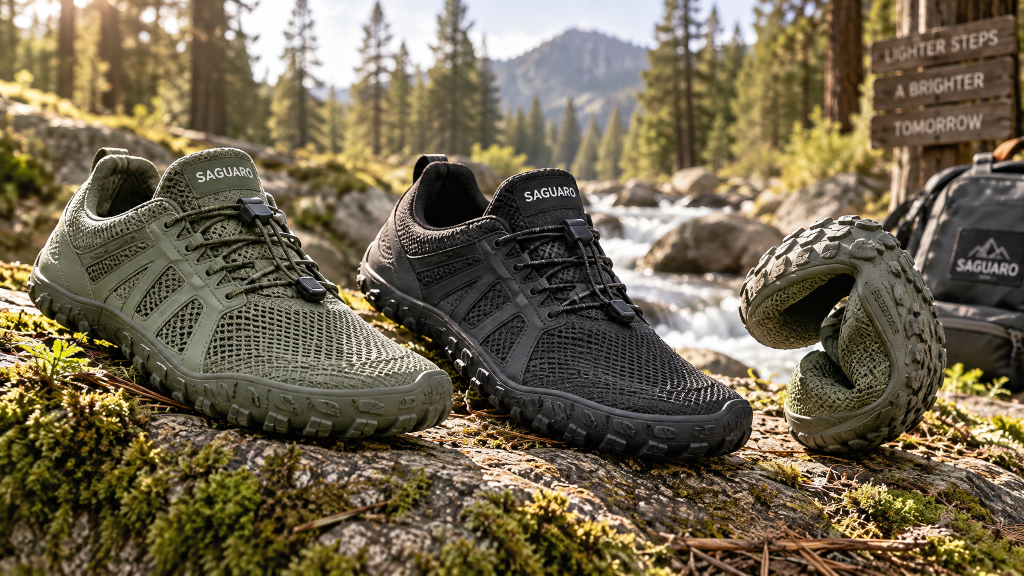
Saguaro is a legitimate barefoot shoe brand that delivers on its core promise: zero-drop, wide-toe, flexible footwear at a price that makes barefoot shoes accessible to more people. The brand’s best models, particularly the Smart and Luck lines, are comfortable, functional, and widely praised by users who understand what they are buying. The kids’ range is a genuine strength, and The Guardian’s recognition of the Free I as the best budget barefoot shoe is a meaningful independent endorsement.
The trade-offs are real and predictable. Durability is inconsistent, finishing is budget-grade, sizing requires careful checking, and the sole can be slippery on wet surfaces. These are not dealbreakers for a casual shoe, but they are limitations that buyers should accept rather than discover.
Who is Saguaro best for?
- First-time barefoot shoe buyers who want to try the category without spending $150
- Casual wearers who want a comfortable, wide-fitting shoe for everyday use
- Parents looking for affordable barefoot shoes for children
- Gym-goers who want a flat, stable training shoe
- Anyone who understands that a $50 shoe will not perform like a $150 shoe
Who should look elsewhere?
- Daily heavy users who need a shoe to last years, not months
- Buyers who prioritize consistent sizing and finishing
- Anyone who needs a shoe for wet, slippery conditions
- People who expect premium materials at a budget price
Overall, Saguaro is worth trying if your expectations match the price. Start with a best-selling model like the Smart II or Luck I, check the specific sizing guidance for that model, and treat it as an affordable entry point rather than a lifetime purchase. At this price, the risk is low and the upside, for many users, is a comfortable shoe that makes barefoot footwear feel accessible.
Scorecard
| Category | Rating |
|---|---|
| Value for Money | ⭐⭐⭐⭐⭐ |
| Comfort | ⭐⭐⭐⭐½ |
| Barefoot Feel | ⭐⭐⭐⭐ |
| Build Quality | ⭐⭐⭐⭐ |
| Durability | ⭐⭐⭐⭐ |
| Sizing Consistency | ⭐⭐⭐⭐½ |
| Customer Service | ⭐⭐⭐⭐½ |
| Overall Rating | 4.7/5 |